


The 2024 expansion of BRICS has undoubtably increased Africa’s weight in international affairs and contributed to the ongoing discussion of the complexities of multipolarity. An increased acceleration of strategic and commercial engagements between BRICS and Africa also reflects the rising pragmatic interest of the major powers in the continent, as well as in China, India, Brazil and Russia. How will the enhancement of the continent’s objective global positioning respond to these pragmatic demands? Is there space for more voices from Africa in BRICS?
As new regional players Egypt and Ethiopia have joined the group, both South Africa and northeast Africa are represented in BRICS, opening possibilities for deeper interstate ties, as well as new financial agreements on the establishment of logistics routes. This could potentially lead to a reduction in financial risks and attract large investments to the region. Expanding the African presence in BRICS is also seen as beneficial to each BRICS country individually: China and India as the two largest investors in Africa, while Russia as a political force that is interested in moving the world towards multipolarity, and Brazil is a country that has a special historical connection with Africa.
A closer look at Ethiopia’s positioning in BRICS raises the question of whether its membership will be a transformative experience for the country, with 27% of its population of 126 mln living below the poverty line. Will it open new opportunities for economic growth and promote regional stability and increased influence on the world stage? If we look at the at it historically, the inclusion of Ethiopia in BRICS seems very natural.
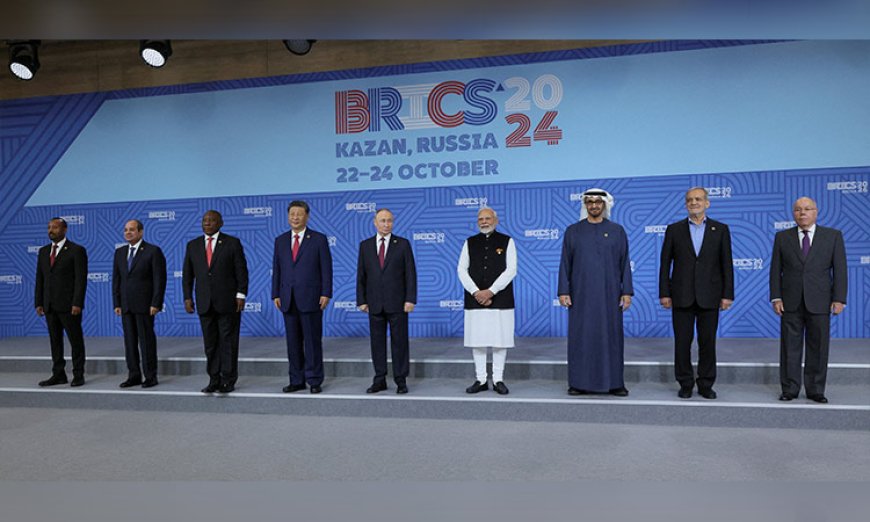
Historically Ethiopia supported the national liberation movements of Africa. Following the independence of many African nations in the late 1950s and early 1960s, Ethiopia remained an important hub for their struggle for decolonisation. Nelson Mandela went for a short military training to Ethiopia as well as some of the ANC revolutionaries. In 1963, after the establishment of the Organization of African Unity (OAU) with its headquarters in Addis Ababa, the city became the symbolic capital of independent Africa. Historically, Ethiopia has great potential in taking the role of a “Pan-African voice” in BRICS. The country is not a WTO member and is looking for what can be called an alternative path for development.
Moreover, Ethiopia’s positioning in the global arena is non-alignment and with regards to the Ukraine crisis, its UN General Assembly voting has demonstrated that it has taken one of the friendliest positions towards Russia among the African states.
When it comes to economic relations, a very brief look into China-Ethiopia relationships shows that currently Ethiopia is the main link in the Chinese “One Belt, One Road” initiative and in 2023, Chinese foreign direct investment in Ethiopia accounted for 39.1% of the country’s total FDI. (National Bank Ethiopia annual report. 2023). According to AiData there were 311 Chinese projects operating in the country in the period from 2000 to 2021. Ethiopia’s rapid economic growth not only attracts Chinese investment, but also directly relies on external earnings, creating a high dependence on China. Nearly the same can be said about India, Ethiopia’s second-largest trading partner and foreign investor. Although Ethiopia’s trade routes do not fall directly within the geographic scope of the North-South Transport Corridor, the country indirectly benefits from India’s infrastructure along this trade route. Ethiopia also has infrastructure cooperation with the United Arab Emirates, which also joined BRICS this year.
Ethiopia seems to already be integrated economically with most of the BRICS infrastructure and its invitation to the group was not only a pragmatic step but also quite natural.
The Egyptian leadership motivated its participation in BRICS more for economic reasons than for political ones. As the country is suffering from a severe economic crisis, the media show different views of what that participation adds to Egypt’s economy. The proposal to open several technology projects through the BRICS New Development Bank, which Egypt has been part of since December 2021, is expected to help stimulate Egypt’s exports in line with its desire to gain access to new technologies within the framework of the grouping.
But how will the inclusion of both Egypt and Ethiopia to the group affect regional security? On the one hand, greater integration should strengthen stability in the east and south of the continent. On the other, the conflict of interests between Ethiopia and Egypt over the construction of a dam on the Nile could increase tensions in northeast Africa, while some observers have high hopes for BRICS in mediating this tension.
To enhance Africans’ agency in BRICS it is essential to work more on the instruments and mechanisms of representation for the smaller and middle-sized African states within the grouping. One of the ways to deal with this could be through collaboration with the African Union. The formats of this collaboration could be different. By working more closely with the AU, BRICS could tackle a wider goal: to stay within the flexible format of an international club and to promote continent-wide pan-Africanist interests. Currently 17 African countries have expressed their wish to join BRICS, but the alliance doesn’t have enough institutional capacity to include everyone as full-scale members.
For Africa the AU-BRICS collaboration could be interesting as well, as it might help solve Africa’s old problem of lack of connectivity within the continent through access to new technologies and infrastructure, which could booster much-needed African integration. This question was explicitly raised by South Africa in the 2nd Johannesburg Declaration’s agenda in clause 34. The statement confirmed mutual support for the African Union’s Agenda 2063 and Africa’s efforts towards integration, including through the operationalization of the African Continental Free Trade Area. The declaration underlined “the importance of strengthening the partnership between BRICS and Africa to unlock mutually beneficial opportunities for increased trade, investment and infrastructure development”. The desire is that deeper integration could help reduce import duties and non-tariff barriers for African exports within BRICS. In some BRICS countries, import duties on agricultural products are as high as 35%; it is assumed that a reduction will increase trade turnover between the countries and increase the competitiveness of African states.
Meanwhile, the African delegates who quite actively attend various BRICS events in Russia continue to say that the continent is looking at BRICS for alternative visions, meaning that it isn’t an anti-Western position, but rather an attempt to pursue different economic trajectories, new approaches to innovation and research, real and people-based solutions to climate change, green energy and food sovereignty, as well as the promotion of indigenous knowledge systems. All these topics are of crucial importance to Africa and how and to what extent the BRICS alliance addresses these global challenges can be traced through the analysis of the alliance’s Declarations, which remain the core resolution paper of the grouping. Recent research conducted by the Centre for African Strategy in BRICS has shown that despite the growing thematic portfolio of global problems that are on the club’s agenda, the states that host the summits put into the Declarations what they regard as their national priorities. Thus for ex., in the Russian declaration of 2020, the topic of historical memory and the fight against Nazism came out. South Africa’s unique input into BRICS’s declarations was the ideas of Pan-Africanism and climate change, which fully corresponded with South African national priorities. It would be very interesting to see what new African member states will put on the menu of their agendas when their turn comes to host the BRICS summits.
Now South Africa is no longer the only African member of BRICS, and that fact will change the country’s positioning in a way that will probably focus more on its regional interests within BRICS. The DRC, Zimbabwe and Angola sent applications to join the club, and being members of the SADC community together with South Africa, they all have the chance to enhance their agency at the multilateral level. This new potential collaboration is considered a real sphere of strategic interest in South Africa.
Finally, having three African regional giants in BRICS doesn’t make the continent fully representative. Nigeria is another concern, as it hasn’t sent an official application, but at some point, it has also expressed its wish to be part of BRICS. Looking at these complex dynamics, it seems that a potential collaboration between BRICS and the African Union might be useful, but that has its own complexities as the question of foreign funding of the AU and its weak institutional mechanisms might challenge the possible integration.














Discussion about this post