


Donald Trump has said there will be no agreement with Iran unless it amounts to “unconditional surrender”, as the war between the United States, Israel and the Islamic Republic entered its eighth day amid intensifying military activity and tentative signs of diplomatic mediation.
The US president issued the warning on social media while simultaneously claiming that Tehran had opened serious discussions with Washington, highlighting the contradictory mix of escalating rhetoric and emerging diplomatic contacts that now define the rapidly widening Middle East conflict.
Writing on Truth Social on Friday, Trump declared: “There will be no deal with Iran except UNCONDITIONAL SURRENDER!”
He added that any eventual settlement would require sweeping political changes in Tehran.
“After that, and the selection of a GREAT & ACCEPTABLE Leader(s), we, and many of our wonderful and very brave allies and partners, will work tirelessly to bring Iran back from the brink of destruction, making it economically bigger, better, and stronger than ever before.”
The comments came only hours after Iran’s president, Masoud Pezeshkian, suggested that international actors had begun attempts to broker an end to the hostilities.
In a message posted on X, Pezeshkian said some countries had “begun mediation efforts.”
“Let’s be clear: we are committed to lasting peace in the region, yet we have no hesitation in defending our nation’s dignity and sovereignty,” he wrote.
“Mediation should address those who underestimated the Iranian people and ignited this conflict.”
War enters second week
The fighting, which began a week earlier with coordinated American and Israeli attacks on Iranian targets in what has been described as Operation Epic Fury, has already caused significant casualties and triggered fears of a broader regional war.
Officials across the region say the conflict has killed at least 1,230 people in Iran, more than 120 in Lebanon and around a dozen in Israel. Six US troops have also been killed.
Military movements suggest that the conflict may intensify further. American strategic bombers including B-1, B-2 and B-52 aircraft are reportedly being redeployed to key staging points including Diego Garcia in the Chagos Islands and RAF Fairford in Gloucestershire.
The long-range bombers, some costing up to $2bn each, are capable of delivering heavy payloads while operating far from their bases and with limited radar detection.
Military sources have indicated that Saturday could mark a new phase of the campaign, potentially involving a much larger wave of strikes exactly a week after the opening bombardments.
Trump himself appeared to foreshadow such escalation earlier this week.
“We haven’t even started hitting them hard. The big wave has not even happened,” he said.
UK bases drawn into conflict
The United States is also expected to increase the pace of operations from bases shared with Britain after receiving approval to use facilities on UK territory for strikes described as defensive.
The US defence secretary, Pete Hegseth, said overnight that the move would significantly expand the scale of American military action.
“When we say more to come, it’s more fighter squadrons, it’s more capabilities, it’s more defensive capabilities, and it’s more bomber pulses more frequently,” he said.
The decision followed several days of hesitation during which Trump criticised the British prime minister, Keir Starmer, suggesting the UK leader had been obstructive.
Trump reportedly described Starmer as “unhelpful” and said he was “no Winston Churchill” during the delay.
British bases are now expected to play a role in targeting Iranian missile facilities and infrastructure linked to Tehran’s military capabilities.
Threat of larger bombardment
Military analysts believe some US aircraft could deploy one of the largest conventional explosives in the American arsenal, known as the “Mother of All Bombs”.
The weapon, a massive 10-tonne explosive, is designed to destroy fortified underground structures such as tunnels and bunkers by creating enormous shockwaves and deep craters.
American MQ-9 Reaper drones armed with laser-guided bombs are also expected to expand their operations over Iranian cities and strategic locations, carrying out precision strikes against military targets.
Additional attacks may also come from aircraft carriers operating in the region and missiles launched from US submarines.
The escalating campaign has been accompanied by stark warnings from the White House.
Following a series of American raids that reportedly killed Iran’s supreme leader Ayatollah Ali Khamenei and senior members of the country’s military leadership, Trump issued a blunt message to Iranian forces.
He warned soldiers to “surrender or die.”
Explosions rock Tehran
The conflict’s intensifying violence was illustrated by one of the largest explosions yet recorded in the war, which struck central Tehran on Friday.
Witnesses reported deafening blasts and large plumes of smoke rising above the city as a significant payload hit the Moqaddad base belonging to the Islamic Revolutionary Guard Corps.
Video footage circulating online showed Tehran’s iconic Azadi Tower standing in the distance while fireballs erupted across the skyline.
Debris was reportedly scattered across large sections of the city centre, with some witnesses claiming they saw bodies thrown more than 100 feet into the air by the force of the blast.
Residents described the strikes as among the most powerful seen since the war began.
Those filming the bombardment could be heard expressing shock at the scale of the explosions, which occurred only hours after Trump’s message urging Iranian forces to surrender.
Separate explosions were also reported near the western Iranian city of Kermanshah, where several missile bases are located.
Lebanon front intensifies
The conflict has also spilled across borders.
Israel launched a series of heavy airstrikes late on Thursday and into Friday targeting the southern suburbs of Beirut and other parts of Lebanon as clashes with Hezbollah intensified.
The attacks were described as the heaviest in the country since a 2024 ceasefire ended the previous war between Israel and the Iran-backed militant group.
Hezbollah had fired rockets at Israel during the early days of the current conflict, raising fears that Lebanon could once again become a central battlefield.
Tens of thousands of people have fled Beirut’s suburbs and parts of southern Lebanon after Israeli evacuation warnings.
Iran targets regional bases
Iran has responded by launching what officials described as its “most intense barrage” of the war.
The attacks involved missiles and drones targeting Israel and US-aligned countries across the Gulf, threatening to expand the conflict to multiple fronts.
Authorities in Qatar said early Friday that their air defences intercepted a drone attack aimed at Al Udeid Air Base, which hosts the forward headquarters of US Central Command.
Saudi Arabia reported that three ballistic missiles fired toward Prince Sultan Air Base south of Riyadh were intercepted and destroyed.
A spokesperson for the Saudi defence ministry confirmed that the base, which also houses US forces, had not been damaged.
In Bahrain, air raid sirens sounded after Iranian strikes reportedly targeted two hotels and a residential building. Officials said there were no casualties.
Kuwait’s army also activated its air defence systems when missiles and drones briefly entered the country’s airspace.
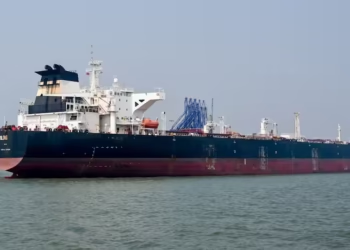
Meanwhile, the US military said it had struck an Iranian drone carrier in the region.
Footage released by the US Central Command showed a black-and-white video of a vessel burning after the strike.
The Iranian government had previously warned that the United States would “bitterly regret” attacking one of its warships.
Trump urges defections
In addition to military threats, Trump has attempted to pressure Iran’s security forces to abandon the government.
He previously called on members of the Islamic Revolutionary Guard Corps, the military and the police to lay down their weapons.
“I’m once again calling on all members of the Iranian Revolutionary Guard, the military and the police to lay down their arms,” Trump said during remarks at the White House on Thursday.
“Now is the time to stand up for the Iranian people and help take back your country. You’re gonna have a chance after all these years to take back your country. Accept immunity, we’ll give you immunity.”
He continued: “You’ll be perfectly safe with total immunity or you’ll face absolutely guaranteed death, and I don’t want to see that.”
Trump also warned that it was “too late” for Iranian officials to negotiate, urging diplomats around the world to defect and align themselves with what he described as the “right side of history”.
At the same time, the president suggested that Washington could influence the choice of Iran’s next leader once the current government falls.
Mixed signals on diplomacy
Despite the hardline rhetoric, Trump indicated on Saturday that Iran had initiated contact to discuss a possible settlement.
Speaking to reporters aboard Air Force One, he said Tehran appeared eager to negotiate.
“Certainly, I can’t tell you that, but we do have very big, powerful ships heading in that direction,” he said when asked whether he had made a final decision on Iran.
“I hope they negotiate something that’s acceptable,” he added.
“We could make a negotiated deal that would be satisfactory, with no nuclear weapons, and they should do that, but I don’t know if they will.”
Trump also told Fox News that the United States could not reveal its military strategy to regional allies during the negotiations.
“We can’t tell them the plan. If I told them the plan, it would be almost as bad as telling you the plan – it could be worse, actually.”
Iranian officials have offered a markedly different account of the diplomatic situation.
President Pezeshkian said Tehran remained committed to dialogue and had consistently pursued negotiations rather than war.
He described Iran’s foreign policy approach as “dignity-based diplomacy” grounded in international law and mutual respect.
Sticking points over nuclear programme
Washington has made clear that any deal must include sweeping restrictions on Iran’s nuclear and missile programmes.
According to US officials, these demands include a complete ban on uranium enrichment, the removal of Iran’s existing enriched uranium stockpile, strict limits on long-range missile development and an end to support for regional proxy groups.
Tehran has rejected those conditions, arguing that its nuclear programme is peaceful and that it has a sovereign right to maintain it.
Nevertheless, signs have emerged that preliminary discussions could be taking shape.
A senior Iranian security official said on Saturday that a framework for negotiations with the United States was beginning to form.
Separate explosions inside Iran
The official’s comments followed two explosions inside Iran earlier in the day that briefly fuelled speculation about new Israeli attacks.
According to Iran’s state news agency IRNA, at least four people were killed when a gas explosion destroyed part of a residential building in Ahvaz, the capital of Khuzestan province.
Separately, another blast struck an eight-storey building in Bandar Abbas, a major port city in the southern province of Hormozgan, killing one person and injuring 14 others.
The cause of the second explosion remains under investigation.
Iran’s Revolutionary Guard Corps navy, headquartered in the province, said no drone attack had been carried out against its facilities.
The organisation also dismissed rumours that its naval commander, Alireza Tangsiri, had been assassinated.
Israeli officials quoted by domestic media also denied involvement.
A security official told Israel’s Kan television network: “We are monitoring, it is not ours or from us.”
Channel 12 News reported that Israeli security agencies believed the incidents were likely caused by an “internal incident.”
Military build-up continues
Even as diplomatic possibilities are explored, the military build-up around Iran continues.
Trump has said a “massive armada” of American naval forces is heading toward the region.
A US guided-missile destroyer, the USS Delbert D. Black, recently made a port call in Eilat at the northern end of the Red Sea.
Iran’s military leadership has responded with warnings of its own.
Army chief Amir Hatami said that any mistake by the United States would endanger not only American forces but also Israel and the wider region.
Meanwhile, Ali Larijani, secretary of Iran’s Supreme National Security Council, wrote on X that the formation of a negotiation structure with the United States was “progressing.”
Potential cooperation on energy
Iran’s foreign minister, Seyed Abbas Araghchi, suggested that a broader settlement could include economic cooperation between Tehran and Washington.
Speaking to the Russian news agency RIA Novosti, he said the two countries might even work together in the energy sector if their disputes were resolved.
Such cooperation, he said, would depend on the United States recognising the peaceful nature of Iran’s nuclear programme.
Diplomatic pressure grows
As the conflict widens, regional and international leaders have intensified calls for diplomacy.
Egypt’s foreign minister, Badr Abdelatty, held a series of telephone conversations with counterparts in Iran, Qatar, Türkiye and Oman, as well as with Trump’s special envoy Steve Witkoff.
During those discussions he urged Washington and Tehran to return to negotiations.
Abdelatty called for both sides to “reach a peaceful, consensual settlement” to the nuclear issue before the conflict escalates further.
For now, however, the war shows few signs of abating.
With military forces massing across the region and the possibility of new large-scale bombardments looming, the fragile diplomatic overtures may face a narrow window before events on the battlefield overtake them.










Discussion about this post