
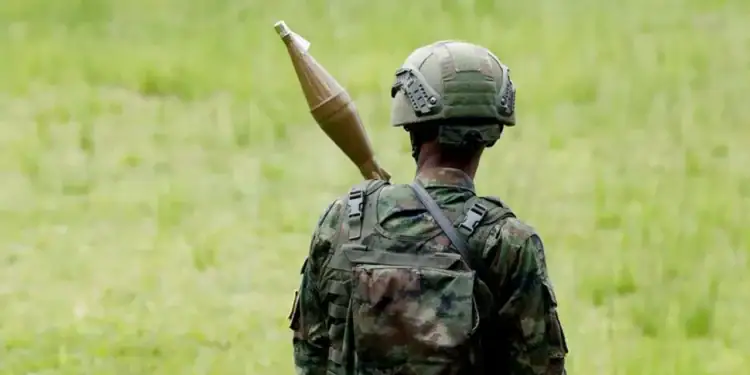
Rwanda has condemned the United States after Washington imposed sanctions on its senior military leadership for allegedly violating a peace agreement with the Democratic Republic of Congo, in a move that risks deepening instability across central Africa.
The sanctions, announced by the United States, target the Rwanda Defence Force (RDF) and four high-ranking officers, including army chief of staff Vincent Nyakarundi. The measures freeze any assets under US jurisdiction and prohibit American individuals and companies from conducting financial transactions with those designated.
US officials said the action was taken in response to Rwanda’s alleged backing of the March 23 Movement (M23), a rebel militia that has mounted a renewed offensive in the mineral-rich east of the Democratic Republic of Congo. Washington accuses the RDF and its senior leadership of playing a “critical role” in enabling M23’s territorial gains.
“The continued backing from the RDF has enabled M23 to capture DRC sovereign territory and continue these grave abuses,” a US State Department spokesman said.
Rwanda swiftly rejected the allegations, accusing Washington of unfairly singling it out while ignoring what it described as wider security threats in the region. In a strongly worded statement, Kigali said the sanctions were “unjustly targeting only one party” and “misrepresenting the reality and distorting the facts of the conflict”.
Rwandan officials insist their country’s involvement in eastern Congo is limited to defensive measures aimed at containing hostile militias operating near their border. Chief among these is the Democratic Forces for the Liberation of Rwanda (FDLR), an armed group formed by remnants of those responsible for the 1994 genocide against the Tutsi. Kigali has long argued that the continued presence of such groups inside Congolese territory poses a direct security threat.
Kinshasa, however, welcomed the US move. The Congolese government described the sanctions as “a clear signal of support” for its sovereignty and territorial integrity, accusing Rwanda of breaching international law by supporting insurgents on its soil.
The resurgence of M23 has reignited one of Africa’s longest-running conflicts. Over the past year, the group has seized strategic towns including Goma and Bukavu, displacing hundreds of thousands of civilians and tightening its grip on key mining areas rich in coltan and gold.
The sanctions come just months after US President Donald Trump brokered a peace agreement between the Congolese and Rwandan governments in December, predicting what he described as a “great miracle”. The deal was intended to halt hostilities and stabilise a region critical to global supply chains for strategic minerals.
Yet within days of the signing, M23 fighters captured the lakeside city of Uvira, casting doubt on the durability of the accord. American officials have since concluded that continued Rwandan support undermined the agreement’s implementation.
Eastern Congo has endured decades of violence since the aftermath of the 1994 genocide in neighbouring Rwanda, with armed groups competing for territory and access to lucrative mineral resources. Multiple regional interventions have failed to produce lasting peace.
The latest diplomatic rupture marks a rare public rebuke of Kigali by a Western partner that has often praised President Paul Kagame’s government for delivering stability and economic growth. Analysts warn that unless tensions are swiftly defused, the confrontation could further destabilise the Great Lakes region and complicate already fragile peace efforts.








Discussion about this post