

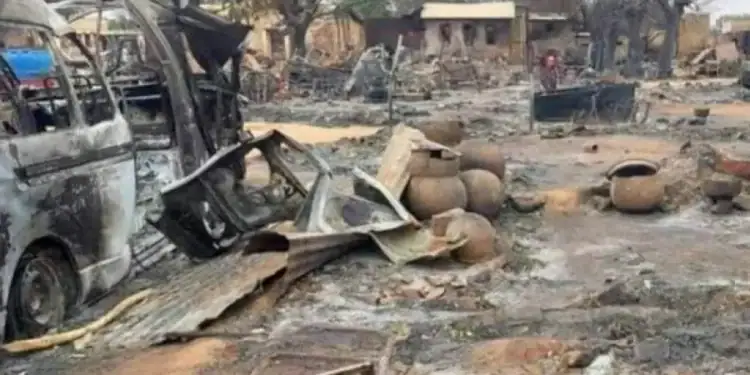
The discovery of at least 169 bodies in a mass grave in northern South Sudan has laid bare the scale of violence engulfing the world’s youngest nation, raising fresh questions about the country’s fragile peace process and the ability of authorities to protect civilians.
Local officials say the dead were killed in an early Sunday morning assault in Abiemnom County, in Ruweng Administrative Area, an oil-producing region that has become increasingly volatile in recent months. The victims, according to the area’s information minister, included women, children and elderly residents.
“This figure may increase further if more bodies are discovered,” James Monyluak, the local information minister, told AFP by telephone, confirming that at least 169 bodies had so far been recovered and buried in a mass grave.
The attack is the latest in a surge of clashes across South Sudan, where armed groups loosely aligned with either government forces or opposition factions have reignited localized conflicts. Although a 2018 peace agreement formally ended a five-year civil war that killed an estimated 400,000 people, the country has struggled to transition from a wartime footing to durable stability.
President Salva Kiir, who has led the country since independence in 2011, presides over a unity government formed with former rival Riek Machar. Yet implementation of key provisions of the peace deal—including security sector reform and the integration of rival armed groups—has been slow and uneven, leaving large swathes of the country awash with weapons and rival command structures.
In Abiemnom, the motives behind the attack remain unclear. A diplomatic source cited by AFP suggested preliminary information pointed to a possible revenge assault, though no group has claimed responsibility. Cycles of retaliation—often linked to disputes over cattle, land or political allegiances—have become a recurring feature of violence in rural areas.
Monyluak said around 50 people were wounded in the attack and transferred to medical facilities in Abyei and neighbouring Warrap State. Medical infrastructure in these regions is sparse, and humanitarian agencies warn that overstretched clinics struggle to cope even in peacetime conditions.
The United Nations Mission in South Sudan, known as United Nations Mission in South Sudan (UNMISS), confirmed that its peacekeepers had opened their base to civilians fleeing the violence. A spokesperson said approximately 1,000 people were being temporarily sheltered within the mission’s compound and that emergency medical care was being provided to the injured.
“The security situation has since stabilised, with government security forces deployed and now in control of the area,” Monyluak said. However, residents who escaped the attack described scenes of panic and chaos, with many fleeing to nearby villages or seeking protection under the blue helmets of UN peacekeepers.
Human rights observers say the scale of the killings underscores the persistent vulnerability of civilians despite repeated pledges by political leaders to curb intercommunal violence. South Sudan’s transitional government has faced mounting criticism for failing to fully unify armed forces, a cornerstone of the 2018 agreement designed to prevent exactly such outbreaks.
Analysts note that the Ruweng Administrative Area sits at the heart of key oilfields, making it strategically significant. Control over oil revenues remains central to political power in South Sudan, where petroleum accounts for the overwhelming majority of state income. Tensions in oil-producing regions often carry both local and national implications.
The discovery of a mass grave also raises the prospect of future investigations into possible war crimes or crimes against humanity. South Sudan’s peace deal provides for the establishment of a hybrid court, in partnership with the African Union, to prosecute serious violations committed during the civil war. That court has yet to be operationalised.
For survivors, immediate concerns are more pressing: shelter, food, medical care and security. Thousands have been displaced in recent months by clashes across different parts of the country, compounding an already dire humanitarian situation marked by food insecurity and flooding.
The Abiemnom killings are a stark reminder that, nearly 15 years after independence, South Sudan’s promise of peace remains fragile. As mass graves are filled and families search for missing relatives, the gap between formal political agreements in the capital, Juba, and the lived reality in remote counties appears as wide as ever.









Discussion about this post