


As the US retreats from the international stage, the most powerful political alliance in the global south has come together in Brazil this week to try to revive and reinvent a collective approach to the world’s problems.
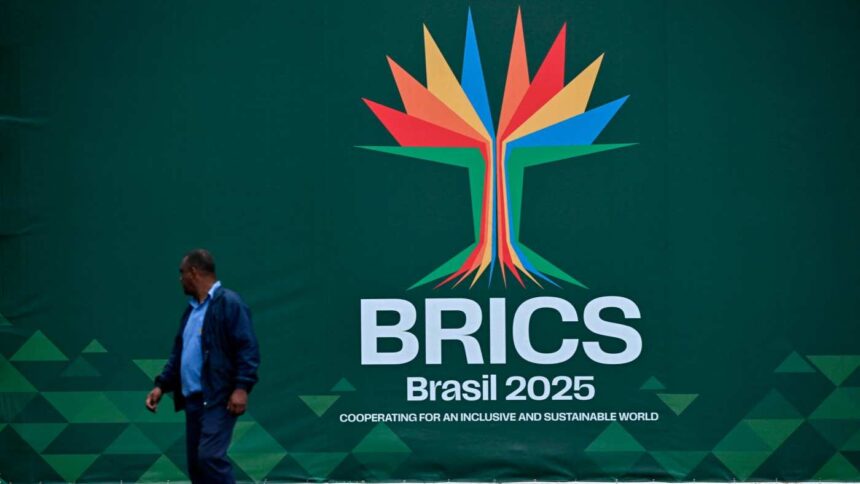
The summit of the Brics group of nations at the Museum of Contemporary Art on the edge of Guanabara Bay in Rio de Janeiro is both a dress rehearsal for the Belém Cop30 UN climate conference in November and a rebuke to wealthier countries that have withdrawn to bunkers, launched missiles and choked off aid to poorer regions.
Opening the Brics conference on Sunday, Luiz Inácio Lula da Silva spelled out the dire global scenario. Eighty years after the defeat of fascism and the creation of the UN, “we have witnessed an unparalleled collapse of multilateralism”, the Brazilian president told leaders. “Hard-won advances, such as climate and trade regimes, are under threat.” The autonomy of the Brics group was being challenged, he warned.
Donald Trump has slapped hefty tariffs on several Brics nations and threatened even higher penalties if the group continues to seek alternatives to the use of the dollar for international trade.
Military tensions are rising. The US has launched missile attacks on one Brics nation, Iran, which Lula denounced along with the “genocide carried out by Israel in Gaza”, the attack on Ukraine (by Russia, a founder member of Brics) and Nato’s decision to allocate 5% of GDP to military spending. “It is always easier to invest in war than in peace,” he said. “The fear of a nuclear catastrophe has returned to everyday life.”
Brazilian diplomats see the Brics alliance as part of an emerging new world order. With Trump pushing the US towards a more insular “America first” outlook, they see an opportunity for the old superpower hegemony to give way to a more equitable, multipolar system of global governance.
And in theory, the Brics grouping should have the heft to drive through changes. Its 11 full members account for 40% of the global population and economy, and more than half of the world’s greenhouse gas emissions – on all of these counts, putting it ahead of the G7 group of the world’s richest, and ideologically capitalist, countries, mostly from the global north. But Brics nations are divided and unbalanced. China has roughly the same GDP and CO2 output as all of the other Brics members combined.
Hence the dismay when President Xi Jinping declined to attend the talks in Rio this week. His first no-show at a Brics summit was not well explained, prompting speculation that China’s enthusiasm for the organisation may have diminished.
“Internal tensions within Brics have increased markedly since 2014,” said Oliver Stuenkel, an associate professor at the School of International Relations at the Fundação Getulio Vargas (FGV) in São Paulo. “And it has become even more difficult since the Russian invasion of Ukraine.”
Vladimir Putin only joined virtually, apparently due to the international criminal court warrant for his arrest. Other notable absences were Egypt’s president, Abdel Fattah al-Sisi, and the Iranian president, Masoud Pezeshkian, who was due to attend the summit before the US and Israeli attacks on his country in June and was deputised by his foreign minister.
The 31-page Rio de Janeiro declaration, which was issued by the leaders on Sunday, condemned the military strikes on Iran, the attacks on Gaza and tariffs, but the language was relatively muted, and there were also soothing reassurances about the importance of the dollar. Analysts said Brazil does not want to reappear on Trump’s tariff radar or to antagonise other countries ahead of Cop30. “There was a general sense of ‘let’s keep this as low key as possible,’” Stuenkel said. “Brazil sees Cop30 as the most important encounter of the year. It has identified climate change as a topic where it can play a leading role.”
The Brics bloc sees itself as a voice for the global south, which is suffering disproportionately from the climate crisis. This provides a strong incentive to try to re-engage the wealthier parts of the world in a multilateral approach to a shared problem. The group was credited with a positive role in the Paris agreement 10 years ago.
Before the conference, the environmental NGO Greenpeace urged Brics leaders to fill the climate leadership vacuum left by the US. “This is a seismic opportunity to drive bold, collaborative global south leadership. Brics nations, several of which are among the most climate vulnerable, must seize this moment and take a decisive stand for people and the planet,” said Anna Cárcamo of Greenpeace Brazil.
In their declaration, the leaders expressed support for multilateralism to address the climate threat and resolved unity to achieve the goals of the Paris agreement. They called for “accessible, timely and affordable” climate finance to ensure a just energy transition. And they welcomed Brazil’s plans to launch a fund at Cop30 aiming to secure long-term financing for conservation. Who will pay remains vague. “We encouraged potential donor countries to announce ambitious contributions,” the statement said. Brazil has reportedly asked China and Brics member states in the Middle East to be among the seed funders. But the bulk of the money is expected to come from wealthy northern-hemisphere nations, which are most to blame for the climate crisis.
There was also pushback against the EU. The statement lamented what it called “discriminatory protectionist measures under the pretext of environmental concerns”, such as carbon border adjustments and moves to encourage deforestation-free trade – both of which are promoted by the EU. There was no mention of a timetable for phasing out oil, coal and gas. Instead, the statement acknowledged “fossil fuels will still play an important role in the world’s energy mix”. Brics now includes several of the world’s biggest oil and gas producers, though it remains behind the G7 – particularly the US, Canada and Australia – when it comes to plans for increased production.
Brics leaders appear most united in their frustration at double standards and exclusionary practices. Rewriting the rules of global governance is the central goal of Brazil, which has called for an overhaul of the UN to make it “more democratic, representative, effective and efficient” and to increase the representation of developing countries in its key decision-making bodies. This has been high on the Brics agenda for many years and partly aligns with recent calls by scientists and civil society groups for a shake-up of UN structures, particularly in the climate process, which was slammed last year as overrun by fossil fuel lobbyists and “not fit for purpose”.
But if this week’s summit was any indication, there is little appetite for accountability or transparency inside Brics. On the first day, media access to national delegations was severely restricted. Civil society groups were absent, perhaps deterred by rows of military vehicles equipped with water cannon and hundreds of troops on closed-off streets, carrying assault rifles.
Brazil, which has always been a great champion of multilateralism, has papered over cracks inside and outside the conference this week, but it will face a still great chasm at Cop30 in November. Preparatory talks in Bonn last month almost came unstuck over money because the EU and other wealthy nations refused to make up the missing climate funds left by the abandonment of the US. This issue – and the widening of war zones – looks likely to haunt the gathering in Belém, when the global south may be left wondering whether the new world order is an opportunity or an illusion.











Discussion about this post