


Kigali, RWANDA — Rwandan President Paul Kagame blamed the inaction of the international community for allowing the 1994 genocide to happen as Rwandans on Sunday commemorated 30 years since an estimated 800,000 people were killed by government-backed extremists.
Rwanda has shown strong recovery and economic growth in the years since, but scars remain and there are questions about whether genuine reconciliation has been achieved under the long rule of Kagame, whose rebel movement stopped the genocide and seized power. He has been praised by many for bringing relative stability but vilified by others for his intolerance of dissent.
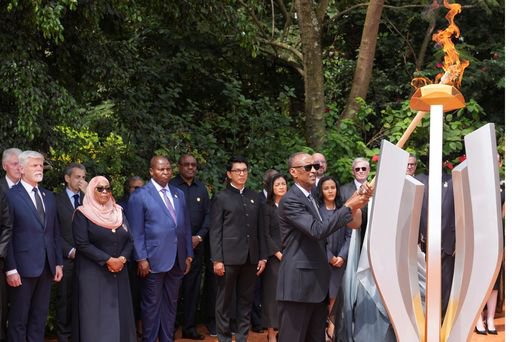
Kagame led somber commemoration events in the capital, Kigali. Foreign visitors included a delegation led by Bill Clinton, the U.S. president during the genocide, and Israeli President Isaac Herzog.
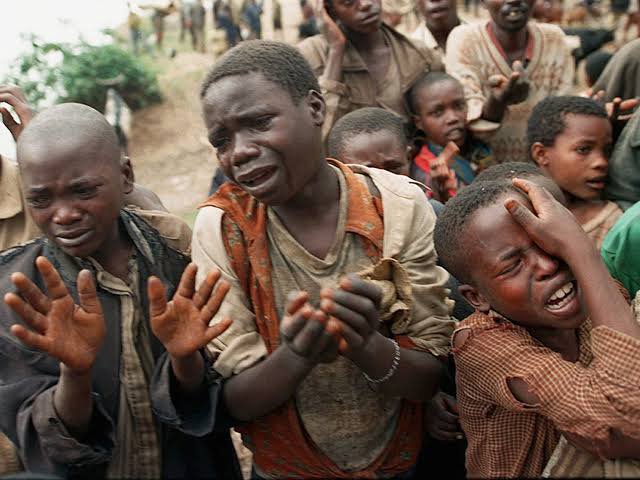
The killings were ignited when a plane carrying then-President Juvénal Habyarimana, a Hutu, was shot down over Kigali. The Tutsis were blamed for downing the plane and killing the president. and became targets in massacres led by Hutu extremists that lasted over 100 days. Some moderate Hutus who tried to protect members of the Tutsi minority were also killed.
Rwandan authorities have long blamed the international community for ignoring warnings about the killings, and some Western leaders have expressed regret.
Clinton, after leaving office, cited the Rwandan genocide as a failure of his administration. French President Emmanuel Macron, in a prerecorded video ahead of Sunday’s ceremonies, said that France and its allies could have stopped the genocide but lacked the will to do so. Macron’s declaration came three years after he acknowledged the “overwhelming responsibility” of France — Rwanda’s closest European ally in 1994 — for failing to stop Rwanda’s slide into the slaughter.
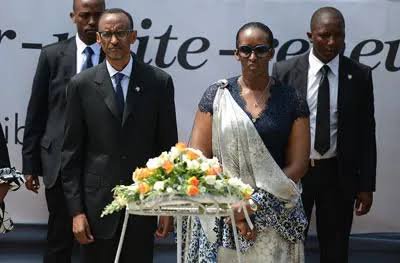
“It was the international community which failed all of us, whether from contempt or cowardice,” Kagame said in a speech after lighting a flame of remembrance and laying a wreath at a memorial site holding the remains of 250,000 genocide victims in Kigali.
He also shared the story of a cousin whose family he tried to save with the help of U.N. peacekeepers. She did not survive.
“We will never forget the horrors of those 100 days, the pain and loss suffered by the people of Rwanda, or the shared humanity that connects us all, which hate can never overcome,” U.S. President Joe Biden said in a statement.
Rwanda’s ethnic composition remains largely unchanged since 1994, with a Hutu majority. The Tutsis account for 14% and the Twa just 1% of Rwanda’s 14 million people. Kagame’s Tutsi-dominated government has outlawed any form of organization along ethnic lines, as part of efforts to build a uniform Rwandan identity.
National ID cards no longer identify citizens by ethnic group, and authorities imposed a tough penal code to prosecute those suspected of denying the genocide or the “ideology” behind it. Some observers say the law has been used to silence critics who question the government’s policies.
Rights groups have accused Kagame’s soldiers of carrying out some killings during and after the genocide in apparent revenge, but Rwandan authorities see the allegations as an attempt to rewrite history. Kagame has previously said that his forces showed restraint in the face of genocide.
Kagame said Sunday that Rwandans are disgusted by critics who have “questioned and revised” the history of the genocide. “Rwandans will always challenge it,” he said, adding that preventing another genocide requires political measures such as those now in place.
“Our journey has been long and tough,” he said. “Rwanda was completely humbled by the magnitude of our loss, and the lessons we learned are engraved in blood. But the tremendous progress of our country is plain to see and it is the result of the choice we made together to resurrect our nation.”
He added, “The foundation of everything is unity. That was the first choice — to believe in the idea of a united Rwanda and live accordingly.”
A night vigil will be held later on Sunday as part of a week of remembrance activities.
Naphtal Ahishakiye, the head of Ibuka, a prominent group of survivors, told The Associated Press that keeping the memory of the genocide alive helps fight the mentality that allowed neighbors to turn on each other, killing even children. Mass graves are still being discovered across Rwanda 30 years later, a reminder of the scale of the killings .
“It’s a time to learn what happened, why it happened, what are the consequences of genocide to us as genocide survivors, to our country, and to the international community,” said Ahishakiye.
He said his country has come a long way since the 1990s, when only survivors and government officials participated in commemoration events. “But today even those who are family members of perpetrators come to participate.”
Kagame, who grew up a refugee in neighboring Uganda, has been Rwanda’s de facto ruler, first as vice president from 1994 to 2000, then as acting president. He was voted into office in 2003 and has since been reelected multiple times. A candidate for elections set for July, he won the last election with nearly 99% of the vote.
Rights activists and others say the authoritarian Kagame has created a climate of fear that discourages open and free discussion of national issues. Critics have accused the government of forcing opponents to flee, jailing or making them disappear while some are killed under mysterious circumstances. Kagame’s most serious political rivals are his Tutsi ex-comrades now living in exile.
Though mostly peaceful, Rwanda also has had troubled relations with its neighbors.
Recently, tensions have flared with Congo, with the two countries’ leaders accusing one another of supporting armed groups. Relations have been tense with Burundi as well over allegations that Kigali is backing a rebel group attacking Burundi. And relations with Uganda are yet to fully normalize after a period of tensions stemming from Rwandan allegations that Uganda was backing rebels opposed to Kagame.
—
By Rodney Muhumuza and Ignatius Ssuuna | AP |











Discussion about this post