


WASHINGTON — Growth in South Asia is expected to be strong at 6.0% in 2024, driven mainly by robust growth in India and recoveries in Pakistan and Sri Lanka. But persistent structural challenges threaten to undermine sustained growth, hindering the region’s ability to create jobs and respond to climate shocks, says the World Bank in its twice-a-year regional outlook.
According to Jobs for Resilience, the latest South Asia Development Update released today, South Asia is expected to remain the fastest-growing region in the world for the next two years, with growth projected to be 6.1% in 2025.
But this strong outlook is deceptive, says the report. For most countries, growth is still below pre-pandemic levels and is reliant on public spending. At the same time, private investment growth has slowed sharply in all South Asian countries and the region is not creating enough jobs to keep pace with its rapidly increasing working-age population.
“South Asia’s growth prospects remain bright in the short run, but fragile fiscal positions and increasing climate shocks are dark clouds on the horizon,” said Martin Raiser, World Bank Vice President for South Asia. “To make growth more resilient, countries need to adopt policies to boost private investment and strengthen employment growth.”
South Asia’s, working-age population growth has exceeded that in other developing country regions. And, while employment growth has also increased, it is well short of working-age population growth. As a result, the share of the employed working-age population has been declining since 2000 and is low. In 2023, the employment ratio for South Asia was 59%, compared to 70% in other emerging market and developing economy regions. It is the only region where the share of working-age men who are employed fell over the past two decades, and the region with the lowest share of working-age women who are employed.
“South Asia is failing right now to fully capitalize on its demographic dividend. This is a missed opportunity,” said Franziska Ohnsorge, World Bank Chief Economist for South Asia. “If the region employed as large a share of the working-age population as other emerging markets and developing economies, its output could be 16% higher.”
These weak employment trends are concentrated in non-agricultural sectors and in part reflect challenging institutional and economic environments that have held back the growth of firms and businesses. Vibrant, competitive firms are key to unlocking employment growth and robust private investment. Stronger job creation would also help households, which have few effective options, to adapt to climate change.
The report recommends a range of policies to spur firm growth and boost employment including increasing trade openness and access to finance, improving business climates and institutions, removing financial sector restrictions, improving education, and removing restrictions on women’s economic activity. And these measures would also help lift growth and productivity and free up space for public investments in climate adaptation.
Country Outlooks
In Bangladesh, output is expected to rise by 5.7% in FY24/25, with high inflation and restrictions on trade and foreign exchange constraining economic activity. Bhutan’s economy is expected to grow by 5.7% in FY24/25, supported by higher electricity production alongside growth in mining, manufacturing, and tourism. In India, which accounts for the bulk of the region’s economy, output growth is expected to reach 7.5% in FY23/24 before returning to 6.6% over the medium term, with activity in services and industry expected to remain robust. Output growth in Maldives is expected to be 4.7% in 2024, a half-percentage point downgrade from previous forecasts as tourists shift from high-end resorts toward lower-cost guesthouses. In Nepal, output is expected to grow by 4.6% in FY24/25 as hydropower exports are expected to pick up but recovery outside the hydropower sector is expected to remain slow. Following the contraction in FY22/23, Pakistan’s economy is expected to grow by 2.3% in FY24/25 as business confidence improves. In Sri Lanka, output growth is expected to strengthen to 2.5% in 2025, with modest recoveries in reserves, remittances, and tourism.
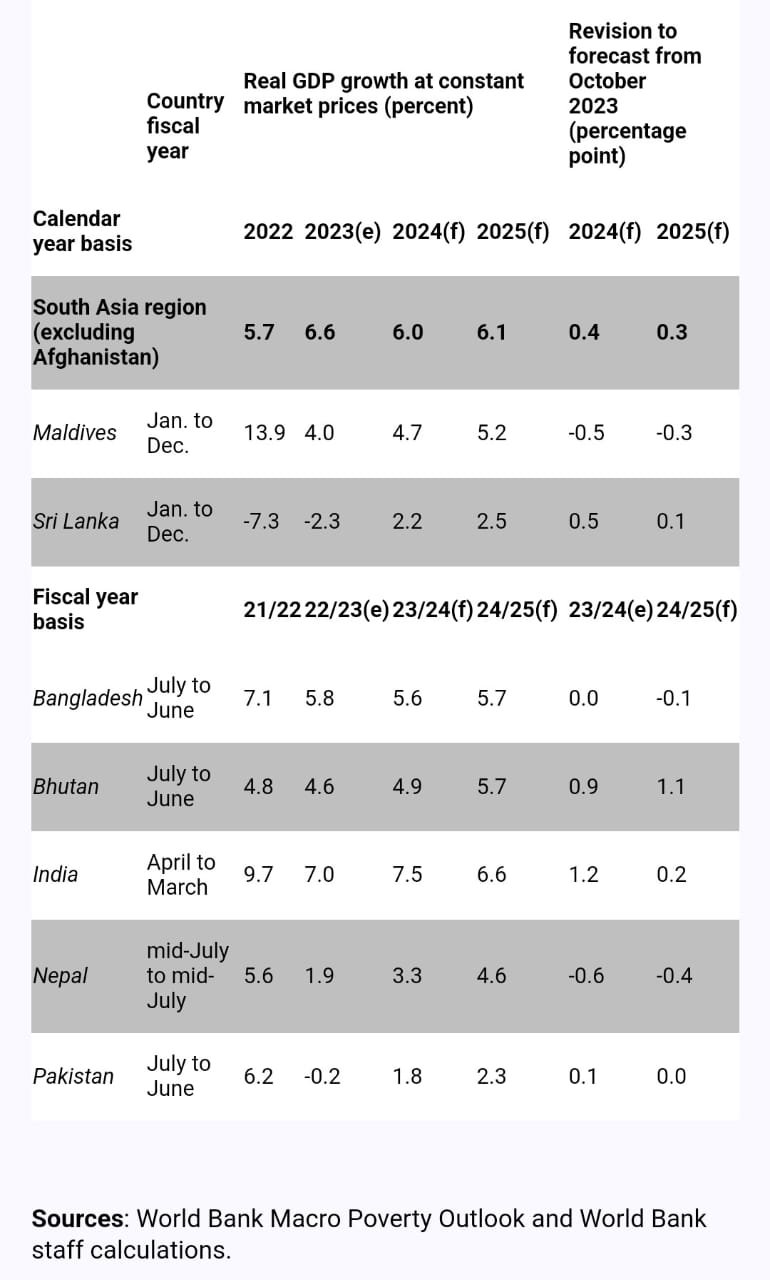
Note: (e) = estimate; (f) = forecast. GDP measured in average 2010-19 prices and market exchange rates. Pakistan is reported at factor cost. National accounts statistics for Afghanistan are not available. To estimate forecasts for regional aggregates in the calendar year, fiscal year forecasts are converted to the calendar year by taking the average of two consecutive fiscal years for Bangladesh, Bhutan, Nepal, and Pakistan because quarterly GDP forecasts are not available.








Discussion about this post