

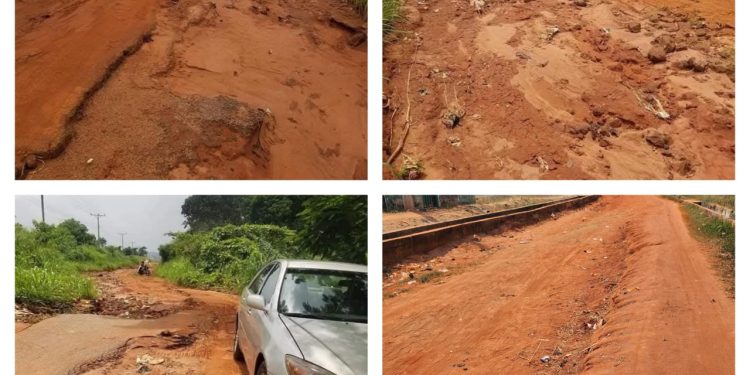
In the oil-rich heart of Delta State, where the land is expected to tell a story of prosperity, the people of Ebu Community in Oshimili North Local Government Area say their reality is one of quiet suffering, isolation, and long-forgotten promises.
For decades, residents say they have watched their community slowly slip into decay—its roads broken beyond recognition, its soil eaten away by relentless erosion, and its economic lifeline steadily severed from neighbouring towns and markets.
Ebu, widely known for its fertile land and strong agricultural output, was once a thriving farming hub in Delta North. Today, many residents describe it as a place cut off from the world.
“We feel abandoned,” one community elder said. “It is like we have been erased.”
Each rainy season brings renewed fear. Torrents of water carve deeper into already fragile roads, widening gullies that now threaten homes, farmlands, and even places of worship. The path leading to the community’s palace—once a central artery of daily life—is now barely passable, forcing residents to navigate mud, erosion channels, and collapsing edges just to move within their own town.
But it is the Ebu–Ezi-Ukala road that has become the most painful symbol of neglect.
Once the main link connecting Ebu to neighbouring communities and local markets, the road is now described by residents as “completely dead.” Traders can no longer transport goods easily. Farmers watch helplessly as harvested crops rot or become too costly to move. Small businesses have collapsed under the weight of isolation.
For many families, this has meant a slow erosion not just of land—but of livelihood.
“Our children cannot even travel freely anymore,” a resident lamented. “Ambulances struggle to reach us. Even basic movement has become a risk.”
Community leaders say the situation has persisted for more than 30 years, with successive administrations allegedly making repeated promises of intervention that never materialised. They argue that Ebu, despite its contribution to food production in the state, has been left without a single functional internal road.
The result, they say, is a community living in physical and economic isolation, cut off from opportunities and trapped in cycles of hardship.
Beyond internal roads, residents also expressed concern over the deteriorating federal road linking the area to Abuja. They allege that heavy-duty vehicles have worsened the condition of the route, turning it into a dangerous passage for motorists and further compounding the community’s isolation.
The feeling among many in Ebu is one of deep frustration and invisibility.
“It is painful,” a youth leader said. “It is like we are not part of the state’s development plans at all.”
As the rains approach once again, anxiety is rising. Families worry about flooding, impassable roads, and the possibility that even emergency services may not reach them in time. Farmers fear another season of loss, while traders brace for further economic decline.
In response to the worsening situation, residents are now making an urgent appeal to Governor Sheriff Oborevwori of Delta State to intervene.
They are calling for a state of emergency on the community’s infrastructure, particularly the reconstruction of access roads and the implementation of erosion control measures. For many, this is not merely a development request but a plea for survival.
“We are not asking for luxury,” one resident said quietly. “We are asking to be connected again—to be able to live like every other community.”
Community leaders warn that continued neglect could push Ebu further into decline, with long-term consequences for food production, local trade, and the wellbeing of thousands of residents.














Discussion about this post