


Some say that beauty is in the eye of the beholder, but not according to these scientists.
A new study claims to have discovered the formula for the perfect woman’s body – and it isn’t about the waist-to-hip ratio as many had assumed.
According to scientists from the University of Konstanz, the most attractive women have a pronounced ‘S’ shaped contour from the chest down to their thighs.
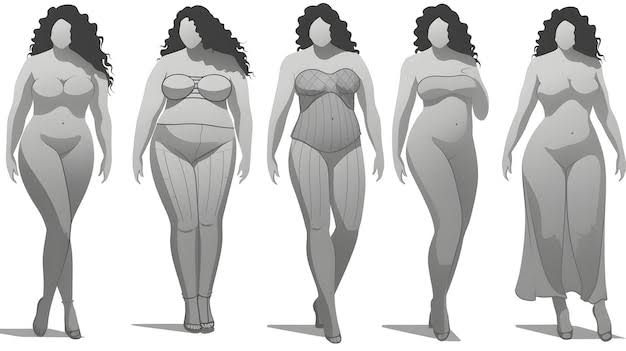
This could explain why curvier stars such as Marilyn Monroe or Kim Kardashian are often considered more attractive than slimmer celebs.
The researchers say it is a woman’s overall ‘curviness’ which makes them appear attractive rather than just having a slim waist.
These findings overturn older research which assumed that a waist-to-hip ratio of 0.7 was the ideal body shape for a woman.
However, the researchers say that a lower waist-to-hip ratio is only attractive for women with a lower body weight.
For larger body types, it is curviness rather than waist size which was the key factor in someone’s attractiveness.
In the past, researchers believed that the ratio between a woman’s waist and hip measurements was a crucial predictor of attractiveness.
That belief, which stretches back centuries, assumed that this mathematical ratio captured something which was inherently aesthetically appealing.
More modern researchers proposed that this ratio could be a sign of underlying reproductive fitness.
Since wider hips and more fat distribution in the lower body have been linked to positive outcomes in pregnancy, evolutionary psychologists suggested that our brains may have evolved to find this ratio attractive.
Typically, a ratio of 0.7, meaning that the waist is 30 per cent smaller than the hips, has been believed to be the ‘ideal’ level for attractiveness.
However, lead author Professor Ronald Hübner argues that the waist-to-hip ratio is a poor substitute for the far more important measure of curviness.
To test this theory, Profesor Hübner first showed 80 male and female participants simple line drawings of women.
These drawings had been prepared so that the waist-to-hip ratio was perfectly aligned with its curviness, meaning that they could not be independently assessed.
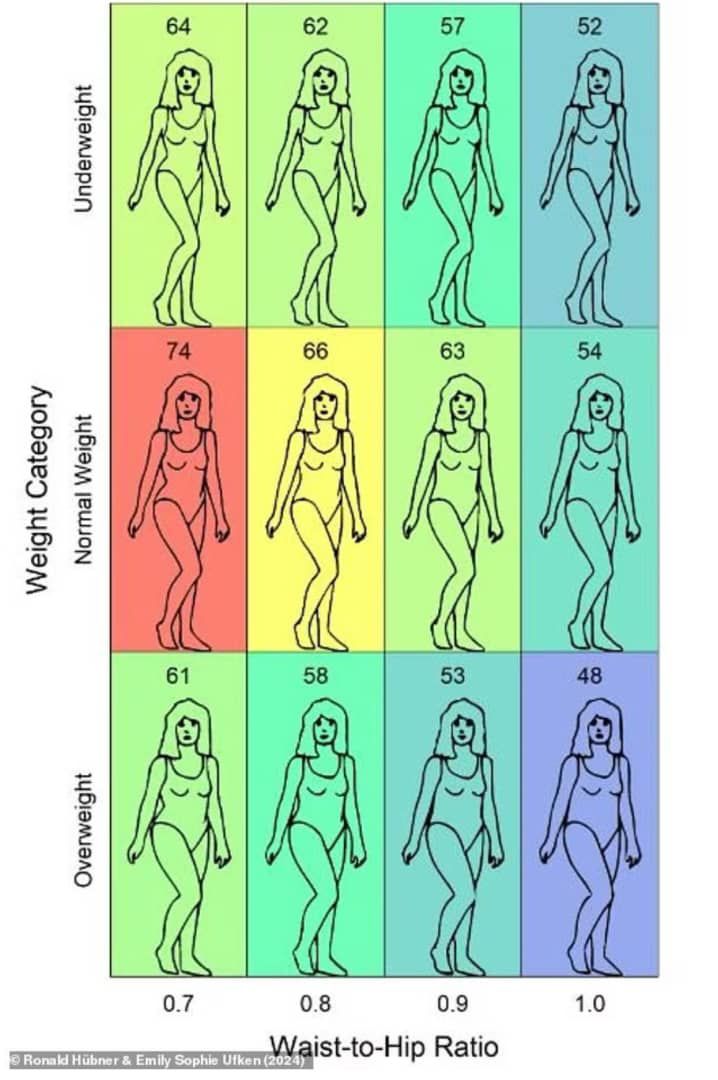
This was done so that the researchers could confirm the results of earlier experiments showing that waist-to-hip ratio predicted attractiveness.
The participants were asked to rate each of the drawings on a scale of one to 100 where one is not attractive at all and 100 is the most attractive possible.
As predicted, the drawings with the hip-to-waist ratio closest to 0.7 were consistently rated as more attractive.
On average a ‘normal weight’ drawing with this ideal ratio had an attractiveness score of 74 while a body of the same weight with a one-to-one ratio was only rated 54.
In a second experiment, the researchers then created a set of drawings where curviness and waist-to-hip ratio were not perfectly aligned.
This would allow them to see which of the two factors better predicted how attractive the drawings would be rated.
The drawings of torsos were made using curves found in pictures of real women wearing extremely tight corsets for the most severe curves.
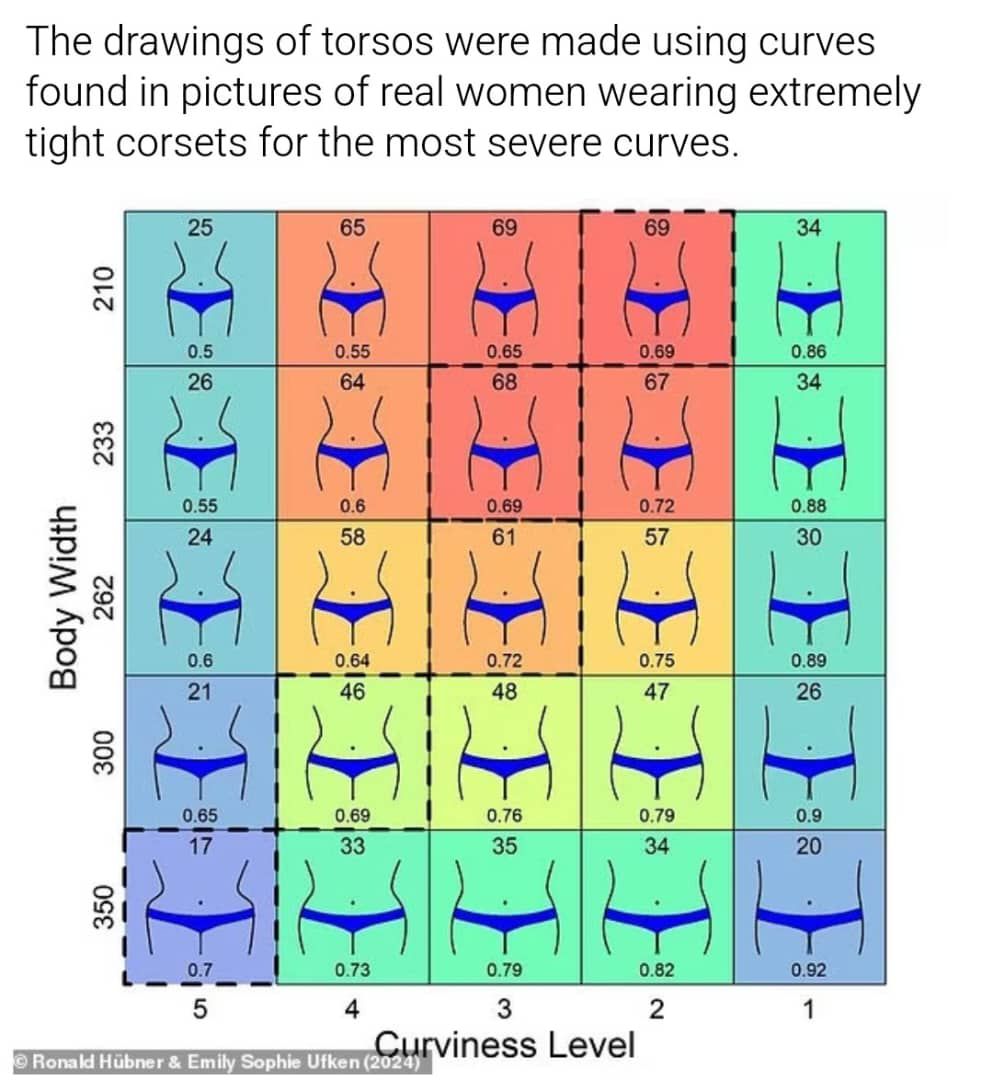
A group of 98 male and female participants were then shown the set of pictures and once again asked to rate them on a scale of one to 100.
As before, a waist-to-hip ratio of 0.7 was rated the most attractive for the smallest body types.
But when it came to wider bodies, having a smaller waist-to-hip ratio ceased to be a good predictor of attractiveness.
In fact, the largest body width with a ratio of 0.7 was rated as the least attractive body type with a score of just 17.
Overall, the torsos with a curviness level of three were rated as the most attractive for their body width, regardless of their hip-to-weight ratio.
In their paper, published in Scientific Reports, Professor Hübner and his colleagues write: ‘Theoretical considerations suggest that the waist-to-hip ratio (WHR) cannot serve as a valid indicator of curviness, contrary to what is frequently assumed, either implicitly or explicitly.
‘Consequently, one of these two attributes must be a more effective predictor of a woman’s body attractiveness. The results of this study clearly show that curviness is far superior to the WHR in this respect.’
As to why this is the case, the researchers once again suggest that curviness could be an outward sign of evolutionarily desirable traits.
Previous studies have suggested that there may be a number of different attributes which could have yielded some advantages in primitive societies.
For example, scientists have noted that large breasts might be considered attractive due to the advantage they would offer during the long weaning periods of hunter-gatherer children.
Some authors have also suggested that a strongly curved spine might have helped women walk for long distances in the past.
Likewise, Professor Hübner argues that curviness could have been a sign of increased fertility which our ancient ancestors evolved to seek out.
The authors write: ‘Body width not only indicates the amount of fat around the hips, but also the pelvic width, which is important for successful birthing.’
This means that curviness might be something our brains are programmed to find attractive at the evolutionary level in a way that the waist-to-hip ratio only partly captures.
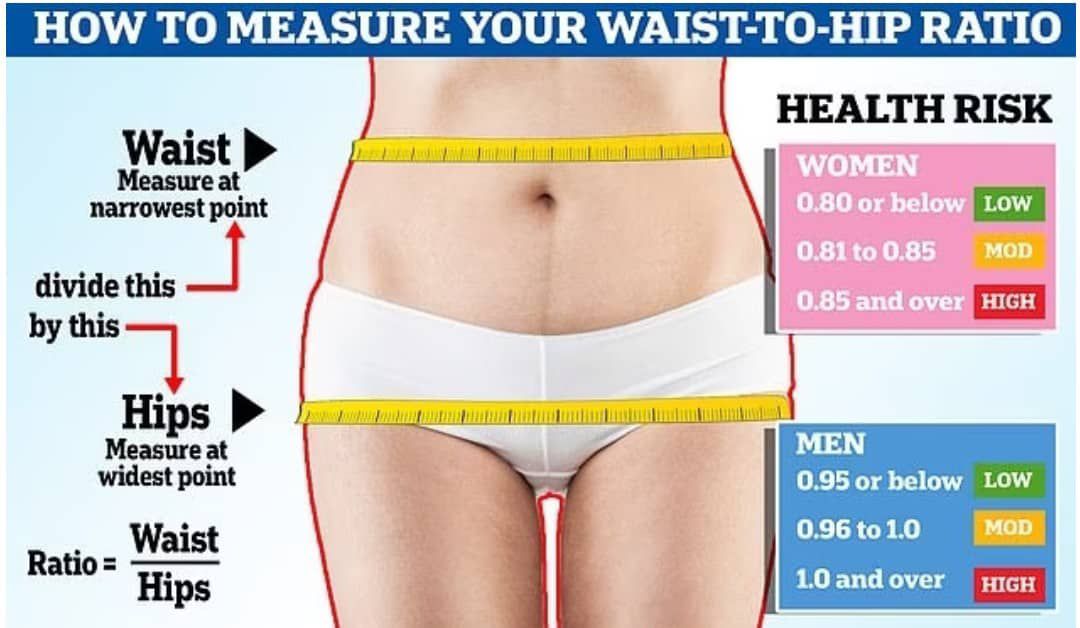 The waist-to-hip ratio is a measure indicating healthy levels of body fat.
Use a tape measure to determine the circumference at you waist — the smallest width of your natural waist, usually just above the belly button.
Then do the same for your hips — the widest part of your buttocks.
Divide the waist measurement by the hips figure to determine the ratio.
For women, the ‘ideal’ score for attractiveness has often been considered to be 0.7.















Discussion about this post