

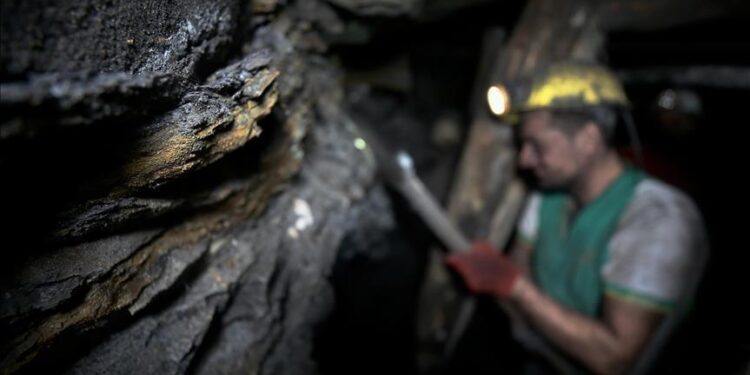
As some European Union countries return to coal to fulfill their energy demand amid Russia’s war in Ukraine, experts are warning of climate risks if these regulations do not remain short-term.
“Germany, Austria, the Netherlands but also France are actually now reactivating some coal power plants, which is very bad news,” said Neil Makaroff, an EU policy officer at Climate Action Network France, an umbrella group on climate.
Though these “very short term” moves do not undermine targets to phase out coal completely by 2030, they still pose “a big risk” due to the environmental impact and cost of coal, Makaroff told Anadolu Agency.
“This would be absolutely dramatic regarding the climate fight, because basically coal is the most emissive, polluting source of energy,” he said, adding that coal “is now very expensive as well.”
European Commission President Ursula von der Leyen warned against “backsliding on the dirty fossil fuels” following announcements by some European countries such as Germany, Austria, and the Netherlands that they would turn to coal with Russia’s war on Ukraine affecting energy supplies.
“We have to make sure that we use this crisis to move forward,” von der Leyen said in an interview with various European media outlets.
On June 15, Russian energy giant Gazprom said some technical equipment sent to the German firm Siemens for maintenance had not yet been returned and warned that gas shipments through the Nord Stream pipeline would decrease.
Gazprom said that only up to 67 million cubic meters (over 2.3 billion cubic feet) of daily gas supplies could be provided through the pipeline as of June 16 — a 60% reduction.
The Netherlands, Germany, and Austria announced that they would put into use their coal plants to reduce gas consumption with the aim of filling gas storage facilities.
Investments in renewables, energy efficiency
Sarah Brown, a senior analyst at Ember, an independent energy think tank, underlined that European governments are making it clear that any increase in the burning of coal would only be temporary.
“Germany has stated that the gas replacement reserve will be set up for only a limited time (until March 31, 2024). It will also be combined with increased energy efficiency and demand management. Germany has at the same time reiterated that the coal phaseout by 2030 is more important than ever,” Brown noted.
While the Czech Republic has reiterated its commitment to a 2033 coal phaseout, Brown said, Romania actually moved its date forward from 2032 to 2030 and the Netherlands has not said it will change its end of 2029 commitment.
“In its latest REPowerEU communication, the European Commission stated that despite temporarily higher coal use in power generation, the climate ambition levels will be reached since REPowerEU leads to investments in renewables and energy efficiency beyond the current Fit-for-55 proposals,” she added.
According to Brown, the current situation has served as a catalyst for clean energy transition in the EU.
“It has been recognized that past mistakes regarding continued reliance on imported fossil fuels and the slow deployment of renewables have caused the energy crisis.
“Gas is no longer viewed as a viable transition fuel, and the push now is towards phasing out both coal and gas as quickly as possible,” she added.
Makaroff echoed Brown’s sentiments, saying that for energy security, and with a green transition, “the only option that we have is actually to develop massively renewable energies in the short term and to reduce our energy consumption drastically.”
Alternatives to reopening coal power plants in Europe
However, Makaroff said there were alternatives to reactivating coal plants in Europe.
“The reopening of coal power plants in Europe is not good for the economy, is not good for the social aspect because it’s very expensive, and is not good for the independence of the European Union,” he said.
“Because simply, most of the coal that we consume today is imported from other parts of the world. Maybe not Russia anymore, but from Colombia, Australia, South Africa,” he added. “This is also a risk at the end for energy independence in Europe.”
Sam Van den plas, a policy director at the Brussels-based Carbon Market Watch, highlighted the importance of clean renewable energy.
“It is clear that none of these governments would be in this position had they taken more serious action in the past to scale up clean renewable power and energy savings measures,” Van den plas said.
“The devastating climate and environmental impacts of coal consumption and mining are well known,” he said. “It has also long been clear that coal is in structural decline, and it shouldn’t have taken Russia’s invasion of Ukraine to realize that fossil gas is not a solution.”
“Had governments started earlier heavily investing in clean renewables and efficiency measures, they wouldn’t now be scrambling to procure expensive fossil gas from across the globe, or importing blood coal from mines where we know workers are subject to human rights violations,” he noted.
Makaroff backed Van den plas.
“Today, renewable energies are clearly the only short-term measure that would make Europe more independent and would avoid harming the climate even more than it is today.”
“Renewable energy is the only way to be more independent and to also fight against climate change,” he added.
Big risk of short-term measures going long-term
For Makaroff, the big risk is that measures that are presented as short-term could linger into the medium- or long-term.
“This should not happen. We should not allow coal power plants to work after 2023 or 2024,” he said.
“We should definitely phase out coal in Europe by 2030. This is the only way to have cheap energy and to limit dependency on big superpowers like Russia.”
According to Brown, this is a lesson to countries outside the EU, especially as the energy crisis and cost of gas is negatively impacting their ability to secure supplies.
“We should see increased acknowledgement that the phasedown of all fossil fuels and the accelerated deployment of renewables, especially wind and solar, is the solution,” she added.
Coal will be a short-term plan to meet energy demand as prices of the highly polluting fuel are getting higher, according to Guven Sak, the managing director of TEPAV, an economic policy research center based in the Turkish capital Ankara.
“We are talking about adapting to a trend 20-30 years from now,” said Sak. “There may be deviations of two or three years within the process.”
He added that it would be best for Türkiye to plan legislation for an exit from coal as soon as possible.



















Discussion about this post