

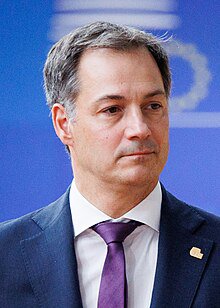
Alexander De Croo, the Belgian Prime Minister, will be co-chairing the first ever Nuclear Energy Summit with IAEA Director General Rafael Mariano Grossi.
Nuclear energy is attracting growing interest from many countries because of its ability to cut the consumption of fossil fuels while meeting rising demand for low-carbon dispatchable electricity, bringing us closer to achieving our global net zero targets. The Summit will be the highest-level meeting to date exclusively focused on the topic of nuclear energy.
The Nuclear Energy Summit will be an opportunity for all participating leaders to share their views on the role that nuclear technology must play — and will play in the coming years —in meeting the decarbonization objectives that we have collectively set ourselves.
Prime Minister De Croo talks to us about the significance of the Summit and the role of nuclear energy in achieving net zero.
What are the key objectives of the Nuclear Energy Summit, and how do you anticipate it influencing global conversations and actions related to nuclear energy and developing technologies?
This is the first time that a global Nuclear Energy Summit has been organized with the participation of heads of State, and this underlines the importance of this meeting, to be held in Brussels on 21 March 2024. The Summit provides an opportunity for all participating leaders to share their views on the role that nuclear technology must play — and will play in the coming years —in meeting the decarbonization objectives that we have collectively set ourselves. This is a strong political signal, recognizing the essential role of nuclear power for many countries around the world on the road to net zero.
Talking about something is good. Implementing solutions is much better. That’s why we’ve decided to combine these discussions at a political level with a scientific symposium that will bring together key industrial stakeholders to enable them to showcase their latest innovations and help them build the bridges and partnerships that will develop the projects of tomorrow.
How do you see nuclear energy contributing to the global transition toward cleaner and more sustainable energy sources, especially in the context of transitioning to net zero?
As part of the solution. For one thing, the war in Ukraine has opened our eyes in Europe to the fact that we can no longer depend on others for our own energy needs. We need to take back control and diversify our energy sources as much as possible. Europe has rediscovered the geopolitical reality of energy policy. At the same time, we need to accelerate our energy transition if we are to meet the climate targets that we have set ourselves for 2050.
Why now? Why do you think there is a need for this Summit?
Just look at how central nuclear energy was in the discussions at COP28 in Dubai. We now need to move from ideas and projects to implementation. That’s the real challenge. We must seize this momentum to create the political and economic space that will enable us to move from PowerPoints to operating projects, whether we are talking about small modular reactors (SMRs) or other innovative solutions that will enable a stable base load for our industries around the world.
Nuclear energy often meets with public scepticism. What strategies do you think are crucial for enhancing public understanding and acceptance of nuclear power to address climate change?
In a way, this shift has already happened. Public awareness of nuclear energy has not been this high in many decades. Even in countries like my own, where nuclear energy was set to be entirely phased out, you see a stark shift in public opinion favouring the contribution of nuclear power in the energy mix. You see this trend in other countries as well. We must seize this renewed support to establish the strongest possible transparency and trust of our public opinion. We cannot afford to downplay the contribution of nuclear power, but let’s not oversell it either. We need to be realistic in our ambitions in terms of how nuclear energy fits in the overall energy mix of countries, and discuss the opportunities and challenges in a transparent way. The first Nuclear Energy Summit can make a major contribution to this objective.
What challenges and opportunities do you foresee in the widespread adoption of nuclear energy on a global scale, and how can these challenges be addressed?
It’s important to me to talk about the opportunities, which are enormous. Climate change is the greatest challenge of the millennium. But we can turn it into a positive result, creating jobs, increasing the quality and resilience of our societies and offering a real future for innovation and our industry. The challenge is to consolidate our efforts by bringing together the expectations of citizens, politicians, our industries and all stakeholders to work together to implement this response, which involves nuclear energy. The goal is to make this Summit a truly global one, to involve partners from around the world. Climate change does not stop at national borders, and phasing out fossil fuels in only one part of the world will not be enough. We need a collective response at the global level that takes account of differences between continents and countries. We are hosting the first Nuclear Energy Summit, and when we make this a success, it will certainly not be the last.
In your view, how can nuclear energy enhance energy security and foster economic development, both nationally and globally?
Look at what we were able to do in Belgium. We steered around 20 year-long policies and reviewed our position to phase out nuclear energy. We did this at a time when we had never invested so much in renewable energies. Belgium’s ambition is to quadruple its production of offshore wind energy in the North Sea to 8 gigawatts (GW) by 2040 and connect our offshore infrastructure with other North Sea countries through the construction of the world’s first energy island. By 2040, this will cover the consumption of 50% of all Belgian households. Not bad for a country with just over 60 kilometres of coastline! But this needs to be complemented by other low carbon energy sources, such as nuclear power. Besides the long-term operation of the Doel 4 and Tihange 3 reactors, we have decided to invest in nuclear innovation at the Belgian Nuclear Research Centre (SCK-CEN) in Mol. Belgium’s ambition is to be part of innovative research into the dismantling of nuclear facilities, medical applications of radioisotopes and the development of fourth-generation SMRs.
Given the advancements in nuclear technology, including SMRs, large reactors and fusion technology, how do you see these innovations shaping the future of nuclear energy and contributing to a more sustainable energy landscape?
Innovation is key to any sector’s future. Transitioning to a net zero future requires an overhaul of our energy systems. We will continue to need an important baseload in our societies, and nuclear energy will continue to play a critical role in many countries in this regard. But we will also need more agile and smarter energy systems if we are to succeed. Our future energy systems will need to be resilient, provide security of supply, be carbon neutral and come at the lowest possible operating cost. Much of the innovation in the nuclear sector is addressing these challenges. It shows that the sector is on the right path.











Discussion about this post