


The road into Chibok is long and red with dust, cutting through farmland that looks deceptively peaceful. Corn stalks bend in the wind. Goats wander lazily across the path. To a stranger, it might feel like any other rural town in northeastern Nigeria. But for the women who live here, every sunrise carries the same unasked question: Will today be the day my daughter comes home?
More than a decade has passed since armed fighters stormed the Government Girls’ Secondary School in Chibok and abducted 276 schoolgirls in the dead of night. The girls were teenagers—students preparing for exams, daughters who had kissed their mothers goodnight just hours earlier. By morning, they were gone, driven into the vast Sambisa Forest by an insurgency that viewed their education as an act of rebellion. The world would soon learn the name “Chibok.” The mothers would learn a new way to live with absence.
In the years since, some of the girls have escaped. Others were released after negotiations. Many remain missing, their fates suspended between rumor, memory, and hope. The headlines have faded, replaced by newer crises and louder emergencies. In Chibok, time has not erased anything. It has only deepened the waiting.
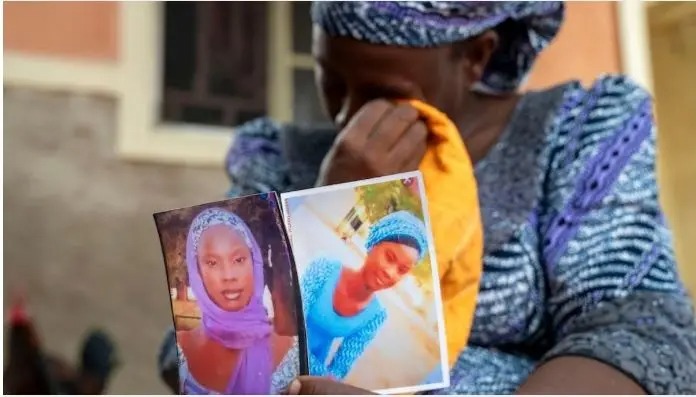
The mothers here measure life differently now. Days are divided not by clocks but by tasks—fetching water, tending crops, preparing meals, sending younger children to school. Their routines are acts of survival, but also of defiance. Boko Haram tried to erase their daughters’ futures. These women respond by insisting on continuity: planting seeds, raising families, believing in tomorrow even when yesterday still hurts.
Yana Galang wakes before dawn, as she has for most of her life. She wraps a scarf around her head, says a quiet prayer, and walks toward her farmland. Her daughter was 18 when she was taken. Today, Yana can no longer remember the exact sound of her voice, only the feeling of her presence. “I hold her in my heart,” she says, pressing a hand against her chest. “That is where she lives now.”
There is no closure in Chibok—only endurance. Mothers live with the knowledge that some girls were forced into marriages, some bore children in captivity, and some may never return at all. The uncertainty is its own cruelty. To mourn would mean accepting death. To hope means reopening the wound every day. Most choose hope, even when it exhausts them.
In the early years after the abduction, the town was flooded with visitors—journalists, activists, politicians. Cameras followed grieving parents. Promises were made. Hashtags spread across the world. For a moment, it seemed as though global attention might force action. Then, slowly, the crowds thinned. The mothers stayed.
They stayed because leaving would mean abandoning the last place their daughters were seen. They stayed because grief had already taken enough. They stayed because someone had to keep the memory alive when the world moved on.
Ladi Lawan sells produce at the local market when she is not farming. The money is small, barely enough to cover school fees and food. She sends her remaining children to school every morning, even though it terrifies her. “Education took my daughter,” she says. “But education is also what will save the others.”
Her laughter, when it comes, surprises even her. It rises suddenly, usually during shared meals or stories among the other mothers. These moments are brief, fragile, and deeply human. Then something shifts—a name mentioned, a memory triggered—and the laughter dissolves into silence. Grief in Chibok does not announce itself. It slips in quietly, sits for a while, then leaves without warning.
The women have formed an unspoken sisterhood. They pray together, work together, grieve together. No one here needs to explain loss. It is understood in glances and pauses, in the way conversations trail off when the subject of the girls arises. Each mother carries her own private grief, but together they bear a collective one.
Children born after 2014 now run through the same fields their missing sisters once crossed on the way to school. Some of them have grown up hearing the names of girls they have never met. To them, the abducted are part of family lore—spoken of in prayers, in stories, in whispered hopes. The mothers worry about what this legacy will mean, but they also know that forgetting would be worse.
Faith plays a central role in survival. Churches fill with women whose prayers have stretched across years. Some pray for miracles. Others pray simply for strength to endure another day. When asked how they continue, many answer the same way: “God knows.”
That belief does not erase anger or doubt. Some mothers openly question why their suffering has lasted so long. Others struggle with resentment toward a government that promised security but delivered uncertainty. These emotions coexist with faith, not in opposition to it. In Chibok, contradiction is part of survival.
There are moments when hope flares unexpectedly. News of a rescued girl, even one unrelated, ripples through the town. Mothers gather, exchanging fragments of information, imagining possibilities. “If she came back,” one might say, “maybe mine can too.” The joy is always tempered by fear—fear of disappointment, fear of learning something unbearable.
For those whose daughters have returned, reunion is not the end of the story. Many girls come back changed, carrying trauma that cannot be undone. Some struggle to reintegrate into communities that do not know how to receive them. Their mothers must learn how to mother again under entirely new circumstances—loving daughters who are both familiar and strangers.
For the mothers whose daughters have not returned, imagination fills the gaps. They picture weddings they did not attend, children they have never met, lives unfolding somewhere beyond reach. These imagined futures are both comfort and torment.
What distinguishes the mothers of Chibok is not that they are stronger than others, but that they have had no choice but to be strong. Strength here is not loud. It is found in persistence—in waking up, in continuing to care, in refusing to let despair have the final word.
The land reflects them. Each planting season begins with uncertainty. Rains may come or fail. Crops may thrive or wither. Still, the women plant. Farming becomes a metaphor they live by: you place something in the ground, you nurture it, and you trust that life will emerge even if you cannot see it yet.
As the sun sets over Chibok, the sky turns a deep orange. Smoke rises from cooking fires. Mothers call children home. In these moments, absence is sharpest. A place at the fire remains empty. A voice is missing from the evening chorus. Yet life continues, not because the pain has lessened, but because stopping would mean surrender.
The story of the Chibok girls is often told as a tragedy frozen in time—a single night, a single crime. For the mothers, it is a living story, unfolding every day. It is written in the lines on their faces, in the fields they tend, in the prayers they whisper into the dark.
They do not ask to be symbols. They do not seek pity. What they want is simple and impossible at the same time: the return of their daughters, or at least the truth of what became of them. Until then, they will keep waiting, keep hoping, keep living.
In a world quick to forget, the mothers of Chibok remember. They remember the girls as they were—laughing, learning, dreaming. They remember because love does not fade with time. It endures, stubborn and unyielding, refusing to be buried by silence.
And so, in this quiet town marked by loss, the mothers remain. They plant. They pray. They raise children. They hold space for daughters who may yet return. Their sadness is vast, but their strength is larger still—a strength rooted not in forgetting, but in remembering, and in the fierce belief that even the longest night must eventually give way to morning.













Discussion about this post