


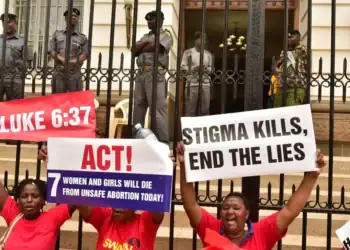
Monrovia, Liberia — Dozens of young Liberian activists marched through the streets of the capital on Thursday to protest what they describe as the country’s worsening rape crisis, delivering a petition to the Ministry of Gender and demanding stronger action from the government five years after rape was declared a national emergency.
The protest began in the Congo Town neighbourhood of Monrovia and ended at the Women’s Peace Hub, where campaigners from the End Rape Campaign addressed supporters and handed their demands to government representatives. Organisers had originally planned to march to the national Capitol building but were prevented from doing so after authorities said the group had not properly secured a permit.
Despite the restriction, demonstrators proceeded with the march and used the gathering to highlight their growing frustration with what they say is slow progress in tackling sexual and gender-based violence.

“The current trajectory of sexual violence in Liberia demands urgent and coordinated national action,” said protest leader Titus Pakalah while reading the campaign’s position statement to the crowd. “Silence, delayed justice and weak enforcement mechanisms have created an environment where perpetrators often act with a sense of impunity while survivors struggle to obtain justice and support.”
The demonstration reflects mounting pressure on the government of President Joseph Boakai to show that Liberia’s legal reforms and policy commitments are producing meaningful change.
Five years ago, former president George Weah declared rape a national emergency amid a surge in reported cases and widespread public outrage following several high-profile assaults. The declaration led to promises of faster trials, better support for survivors and stronger enforcement of existing laws.
Yet activists say the crisis remains acute.
According to official figures from the Liberian National Police, reported cases of sexual and gender-based violence rose by 17% between 2023 and 2024. Advocates and experts caution that the real number of incidents is likely far higher because many victims do not report attacks due to stigma, fear of retaliation or lack of access to the justice system.

At the same time, analysts note that an increase in reported cases could also reflect greater public willingness to come forward — a potentially positive development if it signals growing confidence in law enforcement. Without comprehensive national data, it remains difficult to determine whether the rise reflects increased reporting or a genuine increase in crimes.
Nevertheless, campaigners argue that the persistence of high numbers underscores deep structural weaknesses in Liberia’s response to sexual violence.
In their statement, organisers said rape and other forms of gender-based violence continue to threaten “the safety, dignity and human rights of women, girls and vulnerable members of our society”. They cited delayed prosecutions, weak enforcement of laws, limited survivor services and unequal access to justice as factors allowing perpetrators to act with relative impunity.
The petition delivered on Thursday outlines a series of demands aimed at strengthening Liberia’s institutional response.
Among them are calls for the government to fast-track the prosecution of rape and sodomy cases, expand DNA and forensic services across all 15 counties, and train medical technicians to properly use forensic equipment. Activists also urged authorities to strengthen the capacity of the Liberia National Police to investigate sexual crimes more effectively.
Other proposals include the creation of a national sex offenders registry, the expansion of safe homes and shelters for survivors of abuse, and the inclusion of young people in policy discussions on gender-based violence.
Campaign leaders say the challenge is no longer simply about creating laws but ensuring that they are implemented effectively.
Liberia has introduced several legal reforms over the past two decades. In 2005 the country strengthened its rape law by amending the Penal Code, increasing penalties for offenders and establishing the crime of gang rape. More recently, the Domestic Violence Act — signed into law in 2019 — criminalised domestic abuse and broadened legal protection to cover physical, sexual, emotional, psychological and economic violence within the home.
Despite those reforms, activists argue that implementation remains inconsistent, particularly outside the capital.
The End Rape Campaign’s statement highlighted slow court processes, inadequate survivor support services and the absence of forensic infrastructure in most parts of the country. Liberia currently lacks domestic DNA testing facilities, meaning samples in high-profile cases must sometimes be sent abroad for analysis.
Advocates say this system risks creating inequalities, as only cases with sufficient resources or political attention are likely to benefit from such testing.
The campaign also emphasised the need for greater youth participation in national policymaking, arguing that young people — who make up a large proportion of Liberia’s population — should have a stronger voice in shaping strategies to combat gender-based violence.
Campaigners say the issue has remained one of Liberia’s most serious public safety concerns since the end of the country’s civil conflicts more than two decades ago.
While successive governments have worked with international partners and civil society groups to strengthen legal frameworks and institutional responses, activists say recent data indicates that the scale of the problem remains deeply troubling.
Government officials who received the petition on Thursday welcomed the engagement and promised to review the recommendations.
Ophelia J. S. Kennedy, assistant minister for gender, thanked the demonstrators for staging a peaceful protest and said the ministry valued collaboration with young activists.
“We value this collaboration with you,” Kennedy said while addressing the gathering. “We commend that this awareness initiative has been organised. It is timely and commendable.”
Kennedy said the ministry has established a 116 emergency call centre for reporting cases of gender-based violence and operates a legal unit that coordinates with the Ministry of Justice to help ensure cases move through the courts.
She also pointed to efforts aimed at improving coordination among government agencies and support organisations so survivors can access medical care, counselling and legal assistance more quickly.
According to Kennedy, the ministry recently held a youth dialogue on gender-based violence on 4 March and has secured initial funding to support further engagement with young people.
However, a dispute emerged over whether authorities had blocked the activists’ original plan to march to the Capitol.
Organisers told local media they were denied permission to proceed to the legislative building. But Jutonu Youwateh Kollie, communications director at the Ministry of Justice, rejected that claim.
In a message responding to the allegation, Kollie said organisers had been invited to meet ministry officials but did not attend the scheduled meeting.
He explained that the ministry does not issue permits for demonstrations without first meeting organisers and coordinating with the Liberia National Police to ensure public safety and respect the constitutional rights of other citizens.

“In short, they denied themselves and not the Ministry of Justice,” Kollie said.
For many of the young protesters who gathered on Thursday, however, the procedural dispute over the march route is secondary to what they see as the urgent need for stronger action against sexual violence.
Campaigners say the government’s acknowledgement of the problem must now translate into measurable improvements on the ground.
They want to see faster investigations by police, more effective forensic capacity in hospitals, quicker court proceedings and stronger community-level protection for survivors.
Above all, activists say, Liberia’s anti-rape strategy must deliver results not only in policy statements and official speeches but in everyday institutions across the country.
“The laws exist,” Pakalah said during the protest. “What we are asking for now is proof that they work.”











Discussion about this post