


The village of Hokse in Nepal is known as Kidney Valley because someone from almost every household has sold the human organ. Now poverty is fuelling another health crisis in the country – with kidneys again at the heart of it.
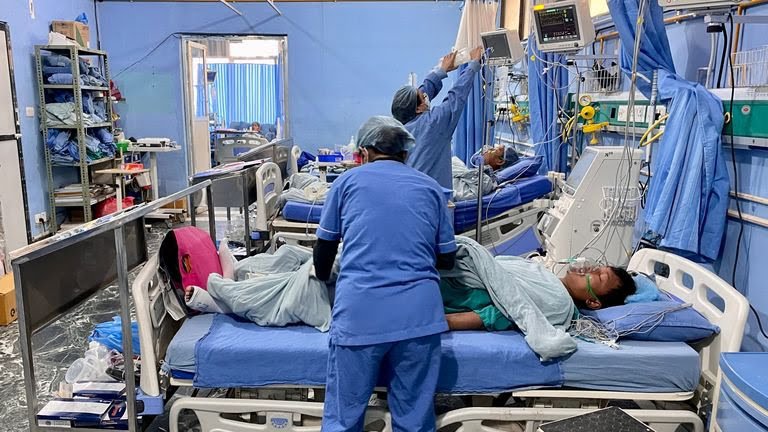
In the foothills of the Himalayas, two men lift their shirts to reveal wide scars on their bodies.
Both aged in their 40s, they appear self-conscious – even embarrassed – but they want to share their story.
The men – called Kanchha and Ram – sold their kidneys, driven by financial desperation. Kanchha is still in pain and unable to work because of the side effects from the surgery.
“It’s impossible to count how many have done it,” he says. “Everywhere, this village, that village, so many people have sold their kidneys.”
The village of Hokse in Nepal has a unique and exceptionally troubled history. It’s known as Kidney Valley because someone from almost every household has sold a kidney.
Brokers have been visiting the area for years, persuading people to part with an organ, despite the fact it’s illegal.
Locals have desperately tried to shake that infamy in recent years – they feel duped, damaged by it. Some say they were exploited, some claim they were even told their kidneys would regrow. Some have died as a result of what was done to their bodies.
And now tragically, poverty is fuelling another health crisis in Nepal – with kidneys again at the heart of it.
Increasing numbers of Nepalis have chosen to work overseas in the Gulf States and Malaysia to make more money for their families back home. But that’s come with its own jeopardy.
Young, once healthy men are returning to Nepal in desperate need of a kidney transplant. Some scientists say it is the result of exposure to extreme heat and severe dehydration.
A few years ago, Suman, 31, was so broken financially and emotionally, he considered ending his life. He felt he had “no option” but to travel to India to sell his kidney to a woman pretending to be his sister.
It was a physically excoriating process that has scarred him. He was paid £3,000.
“I felt weak and I lost consciousness,” he says. “When I woke up, it was really hurting. Now I can’t work and I try to tell anyone I can, not to sell their kidney.”
Suman was not certain if the doctor knew what he was doing but Indian law is clear – donors must be related and they must present the relevant paperwork.
Organ trafficking remains a major concern in India. It is fuelled by a wide gap in demand and supply.
The lack of donors has given rise to a black market, with doctors and hospitals among those exposed in investigations into “cash for kidney” rackets.
But it is not unique to India. Estimates suggest that globally, one in 10 transplanted organs have been trafficked.
“The agents made fake documents in Kathmandu, including Indian ID cards,” says Kanchha, who also sold his kidney in India.
“My kidney was given to a fake sister. I think the doctor in India knew I’d sold it.”
In Hokse, locals insist no-one sells their kidneys any more – but some are still taking extreme risks to try to improve their lives.
Jit Bahadur Gurung spent three years working in Saudi Arabia. Aged just 29, he’s had four hours of dialysis – which he does three times a week – at the National Kidney Center in Kathmandu.
He looks fatigued and withdrawn.
“I had to work in extreme heat – around 50 degrees,” he says. “We didn’t have time to have lunch, go to the toilet or drink water.”
Describing the moment he realised something was wrong, he says: “I was overheating. Suddenly I felt my feet swelling and I couldn’t walk. Then I was told my kidney had failed.”
Symptoms of kidney failure can often go unnoticed and by the time migrant workers arrive back in Nepal, it’s often too late.
Jit is desperate for a donor. But the donor has to be a relative and there aren’t enough positive matches.
Ishwor is 34 and still searching for his lifeline. He says he worked 16-hour days for seven years in Dubai.
“I was working long hours in high heat without sleep,” he says. “My body started to swell up like I’d been beaten.”
Dr Pukar Shresth, a pioneering and renowned surgeon at the Human Organ Transplant Center in Nepal, used to only perform transplants on the elderly, but has recently seen young people with scarred and shrunken kidneys.
He noticed a pattern – young men going to work in high heat, with little water and returning with “completely failed kidneys”.
“It is very grave because about one third of all transplants are these labour migrant workers who have come from abroad,” he says.
“This has caused a huge burden to our health resources health facility because they account for more than 30% of the total transplant number in our country.”
It’s a disproportionate figure since overseas workers represent around 14% of the Nepali population.
Dr Shrestha believes education is key – informing young men going overseas about the importance of having water, taking breaks and a good diet.
A young doctor working alongside him is collecting critical data about where the men have been and what conditions they faced. The men have to have medical tests before they can travel abroad for work, which is why it’s believed they were in good health previously.
The fact is they feel forced to work in some of the world’s hottest places and they have very little agency.
While some countries like Qatar have reduced the hours people can work in the sun, Nepalis’ suffering hasn’t stopped.
Multiple studies have shown the risk of extreme heat in the Gulf States has only escalated in recent years due to climate change.
And a recent report by Human Rights Watch stated migrant workers are mistreated and viewed as “disposable”.
The hospitals of Nepal are a stark warning shot about the dangers of a warming world and the heavy price being paid by those at the coalface.









Discussion about this post