


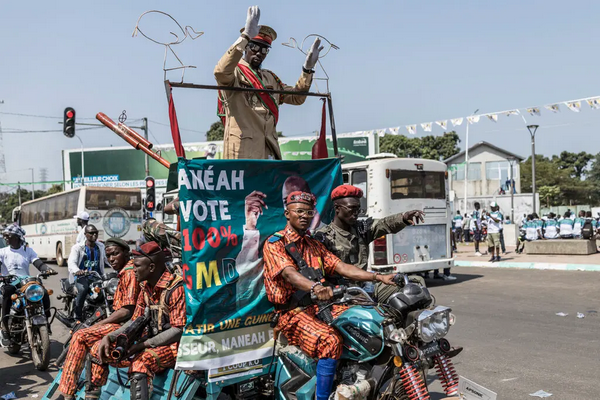
Conakry, GUINEA – Voters in Guinea went to the polls on Sunday in a high-stakes presidential election that marks a pivotal moment in the West African nation’s turbulent political history. At the centre of the contest is Colonel Mamady Doumbouya, the leader of the ruling military junta, who is seeking to convert his hold on power into electoral legitimacy after four years of transitional rule following a coup.
Colonel Doumbouya, a former special forces officer, seized power in 2021 by ousting President Alpha Condé, Guinea’s first democratically elected leader. At the time, he promised a swift return to civilian governance. Yet, despite repeated deadlines, the country has yet to see a full transition. Last year, Colonel Doumbouya introduced a new constitution that opened the door for him to run for president, a move widely viewed as consolidating his grip on the country.
The electoral landscape has been markedly constrained. Several of the country’s most prominent political figures have been barred from running, including former Prime Ministers Cellou Dalein Diallo and Sidya Touré, as well as Mr. Condé himself, who had been ousted after controversially seeking a third term by abolishing presidential term limits. Analysts say these exclusions have effectively cleared the path for Colonel Doumbouya.
Among the few challengers left in the race is Abdoulaye Yéro Baldé, an economist and former higher education minister under Mr. Condé’s administration. Seen by many as the strongest opposition candidate, Mr. Baldé has decried the prevailing political climate as oppressive. “The environment is not conducive, but we have to stand our ground and defend our rights,” he said in a recent interview.
Journalists and civil society members have faced increasing pressure under the junta. “Journalists are afraid to talk,” Mr. Baldé said. “People disappear for no reason. Media houses are shut down. People are getting killed.” Amnesty International reports that at least 47 protesters have been killed since the 2021 coup, while spontaneous demonstrations have been violently suppressed and later banned outright.
The election comes as Guinea draws growing attention for its mineral wealth. The country is the world’s leading exporter of bauxite, an essential component in the manufacture of aluminium for planes and automobiles. In addition, last month Colonel Doumbouya inaugurated the Simandou iron ore project, one of the world’s largest, which had been stalled for over 30 years due to ownership disputes, political instability, and the immense costs of development. Now completed at a reported $11.6 billion, the project is central to the junta’s narrative of national development.
“The Simandou project is at the centre of Doumbouya’s platform and is definitely a promising initiative,” said Aissatou Kante, a policy researcher at the Institute for Security Studies in South Africa. “It is expected to bring several hundred million dollars a year into Guinea’s economy and provide a significant boost to the country’s GDP.”
Yet turning mineral wealth into tangible benefits for the population remains a complex challenge. More than half of Guinea’s population lives below the poverty line, according to the World Bank. Analysts caution that managing the competing interests of foreign investors and global powers, while ensuring that revenues benefit the nation, will test whichever leader emerges victorious.
Unlike several of its Sahelian neighbours, which have leaned heavily towards Russia and away from Western partners, Guinea’s junta has pursued a more pragmatic approach, welcoming investment from all quarters without formal alignment with any global power. “The junta’s approach is pragmatic: Take capital where it comes, but keep no single partner indispensable,” said Vincent Rouget, head of political and business risk analysis for sub-Saharan Africa at Control Risks. “So far, this strategy has paid off, and it is likely to continue.”
Domestically, Colonel Doumbouya has cultivated an image of a builder and moderniser. His administration has initiated road construction and railway projects to improve connectivity in a country where infrastructure remains limited. Yet critics warn that the junta’s control over public information, particularly regarding mining contracts, raises serious questions about transparency and accountability.
The electoral process itself has drawn scrutiny. Guinea’s new constitution stipulates that presidential candidates must reside in the country, automatically disqualifying Mr. Diallo, Mr. Condé, and Mr. Touré, all of whom have been in exile since the 2021 coup. The Supreme Court, whose term was recently extended, will oversee the announcement of the results. Notably, the elections are being managed by a government ministry rather than an independent electoral commission, dissolved in the aftermath of the coup.
“There’s essentially no real political competition,” Ms. Kante said. “The main question is really about voter turnout, and if it is high, it will give the incumbent president a stronger legitimacy.” Analysts predict that Colonel Doumbouya, who has largely avoided campaigning, is poised for an easy victory due to the fragmentation and weakness of the opposition.
Nevertheless, Mr. Baldé insists that his campaign can resonate with voters. “People are surprised at how I am able to motivate large crowds,” he said. “The people want change. It is a dictatorship, and Guineans are looking for hope.” He argues that the electorate is eager for a return to genuine democracy and an end to the climate of fear fostered by the junta.
The stakes of the election are heightened by Guinea’s mineral boom. The Simandou project, along with continued bauxite expansion, places the country at the heart of the global race for critical minerals, and investors are watching closely. Success could translate into substantial economic gains, but mismanagement could exacerbate existing inequalities and fuel unrest.
Even within a region increasingly dominated by military rulers, Sunday’s vote represents a tentative nod to electoral processes. Mali, Niger, and Burkina Faso have all seen recent elections and transitions delayed or annulled by military leaders. In this context, the Guinean vote, imperfect though it may be, is being interpreted by analysts as a strategic move to secure legitimacy and buy time to implement economic policies.
Polling stations opened at 8 a.m. local time and closed at 6 p.m., with provisional results expected within days and the final outcome due from the Supreme Court within two weeks. Observers will be watching voter turnout closely, as it will serve as a key indicator of the junta’s ability to claim popular support.
In the end, the election is less a contest between rivals than a referendum on Colonel Doumbouya’s rule. With his rivals barred, the country’s political future—and the potential of its vast mineral wealth—now hinges on the junta leader’s ability to translate authority into legitimacy, and investment into tangible progress for a population that has long awaited both.











Discussion about this post