
Sunday, May 10, 2026
  • Who’sWho Africa AWARDS
  • About One Africa Magazine
  • Contact Us
www.oneafricamagazine.com
  • Home
  • Magazine
  • News
  • Interviews
  • Sports
  • World News
    • US
    • South America
    • Asia
    • Europe
    • Middle East
    • Australia and Antarctica
  • Crime
  • Politics
  • Lifestyle
  • Column
  • Special Report
  • WHO’SWHO AWARDS
No Result
View All Result
www.oneafricamagazine.com
  • Home
  • Magazine
  • News
  • Interviews
  • Sports
  • World News
    • US
    • South America
    • Asia
    • Europe
    • Middle East
    • Australia and Antarctica
  • Crime
  • Politics
  • Lifestyle
  • Column
  • Special Report
  • WHO’SWHO AWARDS
No Result
View All Result
www.oneafricamagazine.com
No Result
View All Result
  • Home
  • WHO’SWHO AWARDS
  • News
  • Magazine
  • World News

Home » Health » British company breeding genetically engineered mosquitoes in Africa

British company breeding genetically engineered mosquitoes in Africa

The company says the mosquitoes it breeds cannot spread malaria and plans to begin releasing them in Djibouti City by the end of the year

December 30, 2025
in Health
0
Share on FacebookShare on Twitter

A British company breeding mosquitoes whose offspring cannot spread malaria is set to start releasing the insects into Djibouti city by the end of the year.

Genetically-engineered male mosquitoes hatched in boxes placed around the East African capital will produce female babies with genes that cause them to die before they reach adulthood. Only female mosquitoes bite and spread disease.

The scheme is designed to slash the number of mosquitoes to reduce cases of malaria, which currently infects up to 10 per cent of the country a year. Malaria is among the world’s biggest killers of children under five.


ReadAlso

After losing influence in West Africa, France seeks a regional reset

Woman jailed in Somalia for peaceful protest ‘stripped, kicked and beaten’

Outside of the mosquito 'factory' in Djibouti City
Outside of the mosquito ‘factory’ in Djibouti City (Oxitec)

“So much has been achieved with existing tools,” like bed nets and insecticide spraying, says Neil Morrison, chief strategy officer at Oxitec, the British biotech company which produces the altered mosquitoes. “But progress is stalling” as resistance is being built up.

As global funding to fight malaria reduces, thanks to cuts by the US, UK and a number of other nations, Morrison adds: “We just need to get a bit smarter in terms of how we think about controlling mosquitoes.”

ADVERTISEMENT

A piece of code is inserted into the genetic material of the mosquitoes at a research facility in the UK, before the “friendly” mosquitoes are transported to a “mosquito factory” in Djibouti, Morrison explains. A chemical antidote is then given to the mosquitoes to “switch off” the code, allowing them to survive and breed within that “factory”.

Once a breeding colony is established, male eggs containing the code that will stop their female offspring from surviving and therefore spreading malaria are hatched into the environment.

“They just add water and close the lid. And over the next few days, our friendly male mosquitoes develop and then emerge from the box to look for local females,” Morrison says.

The boxes could be placed on lamp posts, outside shops or in people’s front yards – the company is still testing where they are most likely to survive in the hot, humid environment. This helps drive down the number of biting mosquitoes in the local area as the gene causing female mosquitoes to die before reaching maturity spreads.

Thousands of genetically modified adult mosquitoes were already released onto the streets of the city last year as part of a pilot.

Djibouti had been close to eliminating malaria when a species of mosquito called Anopheles stephensi, generally found in Asia and the Middle East, appeared in the country for the first time. Cases of malaria skyrocketed from around 30 cases in 2012 to more than 70,000 in 2020.

The scale of the deaths, “impacted public health and impacted the economy, that impacts schools, that impacts everything”, says Colonel Dr Abdoulilah Ahmed Abdi, health adviser to the president of Djibouti.

The mosquito species – never seen in Africa before the last decade – has since spread through the continent to Kenya, Sudan, Ethiopia, and even as far as Nigeria.

Part of what makes this mosquito so problematic is that, unlike most others, it breeds in densely populated urban areas rather than rural communities, infecting many more people faster. It is resistant to common insecticides. And it can bite in the daylight, not just at night, making bed nets less useful.

Oxitec was approached by the Djiboutian government, asking for help with the mosquito after officials learned of their work breeding a different species of the insect to tackle dengue fever in Brazil.

The company partnered with Djibouti’s national ministry of health, which is running the programme on the ground, including answering local people’s questions who might have concerns about the mosquitoes being released into their communities.

“We definitely get questions. For many people, this is an entirely new concept, you know, not always intuitive that you release mosquitoes to control mosquitoes,” Morrison says.

Amid cuts to foreign aid from a number of rich countries, including the UK, the world’s largest provider of malaria prevention, the Global Fund, has fallen short of its funding target by a third, or $6bn, meaning it will have to scale back its ambitions for the next three years.

Colonel Dr Ahmed Abdi says the mosquito production unit is important in the fight against malaria in part because “Djibouti is involved in developing this technology”, and is providing its own funding on top of the donor funding.

Morrison says public-private partnerships are playing an “increasingly important role” as global funding reduces.

“What we’re seeking to do,” he adds, “is to reduce reliance on existing tools and put promising new technologies in the hands of African governments.”

Gareth Jenkins, managing director of charity Malaria No More UK, says: “Growing resistance to a number of tools and funding cuts mean a malaria resurgence is now a real possibility, with millions of children’s lives at stake.

“But investment in innovation is our secret weapon in the fight back against malaria, and the progress on genetic modification is a perfect example of that.”
Related

Tags: AfricaBiotechnologyMalariaMosquito ControlPublic Health
ADVERTISEMENT
Previous Post

Beyond The Ring: Full Report of Anthony Joshua Car Crash

Next Post

Guinea Election: Military junta Col Doumbouya Seeks Legitimacy Amid Banned Rivals, Mineral Boom

You MayAlso Like

Health

World Asthma Day 2026: CIDO Foundation Provides Free Asthma Care in Delta State

May 6, 2026
Health

Africa’s Biggest Science Festival 2026 Brings 27 Nations Together in Abidjan

April 23, 2026
Health

Early signs of Parkinson’s disease is shown in the gut, study finds

April 20, 2026
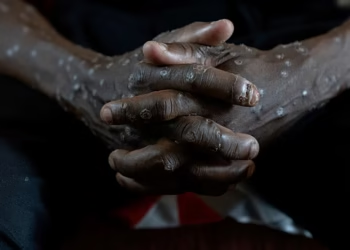
A man suffering from monkeypox waits for treatment at Kamituga General Hospital in South Kivu (Congo), on September 4, 2024.   - 
Copyright © africanews
AP Photo/Moses Sawasawa
Health

Congo declares end of two‑year Mpox outbreak that killed over 2,000

April 3, 2026
Health

What is eye stroke? The rare side effect linked to weight loss injections

March 21, 2026
Health

Nigeria Lassa Fever Cases Fall but Death Rate Rises in 2026 Outbreak

March 17, 2026
Next Post

Guinea Election: Military junta Col Doumbouya Seeks Legitimacy Amid Banned Rivals, Mineral Boom

Court remands Malami, Son, Wife to Kuji Correction Centre

Discussion about this post

US ‘Shameless Exploitation’ in Proposed Zambian Health Aid Deal Exposed

Pastor Idowu Okeze’s Empowerment in Igbuzo Described as Organic, Not Political

Renewed Hope for Nollywood Backs Tinubu’s Creative Economy Agenda

Ghana becomes latest African country to reject US health deal

Woman jailed in Somalia for peaceful protest ‘stripped, kicked and beaten’

Algeria to Become Arab World’s 4th Largest Economy by 2026, IMF Data Shows

  • US ‘Shameless Exploitation’ in Proposed Zambian Health Aid Deal Exposed

    542 shares
    Share 217 Tweet 136
  • Pastor Idowu Okeze’s Empowerment in Igbuzo Described as Organic, Not Political

    541 shares
    Share 216 Tweet 135
  • Renewed Hope for Nollywood Backs Tinubu’s Creative Economy Agenda

    541 shares
    Share 216 Tweet 135
  • Ghana becomes latest African country to reject US health deal

    541 shares
    Share 216 Tweet 135
  • Woman jailed in Somalia for peaceful protest ‘stripped, kicked and beaten’

    541 shares
    Share 216 Tweet 135
  • Trending
  • Comments
  • Latest

US ‘Shameless Exploitation’ in Proposed Zambian Health Aid Deal Exposed

May 10, 2026

Pastor Idowu Okeze’s Empowerment in Igbuzo Described as Organic, Not Political

May 10, 2026

Renewed Hope for Nollywood Backs Tinubu’s Creative Economy Agenda

May 10, 2026

Ghana becomes latest African country to reject US health deal

May 10, 2026

US ‘Shameless Exploitation’ in Proposed Zambian Health Aid Deal Exposed

May 10, 2026

After losing influence in West Africa, France seeks a regional reset

May 10, 2026

Algeria to Become Arab World’s 4th Largest Economy by 2026, IMF Data Shows

May 10, 2026

Mixed reactions trail Niger’s ban on French broadcasters

May 10, 2026

ABOUT US

www.oneafricamagazine.com

TIMEAFRICA MAGAZINE is an African Magazine with a culture of excellence; a magazine without peer. Nearly a third of its readers hold advanced degrees and include novelists, … READ MORE >>

SECTIONS

  • Aviation
  • Column
  • Crime
  • Europe
  • Featured
  • Gallery
  • Health
  • Interviews
  • Israel-Hamas
  • Lifestyle
  • Magazine
  • Middle-East
  • News
  • Politics
  • Press Release
  • Russia-Ukraine
  • Science
  • Special Report
  • Sports
  • TV/Radio
  • UAE
  • UK
  • US
  • World News

Useful Links

  • AllAfrica
  • Channel Africa
  • El Khabar
  • The Guardian
  • Cairo Live
  • Le Republicain
  • Magazine: 9771144975608
  • Subscribe to TIMEAFRICA MAGAZINE biweekly news magazine

    Enjoy handpicked stories from around African continent,
    delivered anywhere in the world

    Subscribe

    • About One Africa Magazine
    • Privacy Policy
    • Contact Us
    • WHO’SWHO AWARDS

    © Copyright TimeAfrica Magazine Limited 2026 - All rights reserved.

    No Result
    View All Result
    • WHO’SWHO AWARDS
    • Politics
    • Column
    • Interviews
    • Gallery
    • Lifestyle
    • Special Report
    • Sports
    • TV/Radio
    • Aviation
    • Health
    • Science
    • World News

    © Copyright TimeAfrica Magazine Limited 2026 - All rights reserved.

    This website uses cookies. By continuing to use this website you are giving consent to cookies being used. Visit our Privacy and Cookie Policy.