
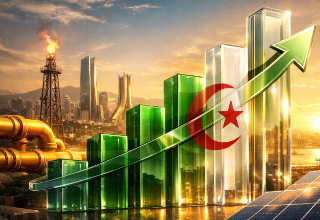
ALGIERS – Algeria is reshaping the Arab economic landscape, with new International Monetary Fund (IMF) projections placing the country on course to become the fourth-largest Arab economy by 2026, measured by purchasing power parity (PPP).
According to the IMF’s World Economic Outlook (October 2025), Algeria’s gross domestic product (GDP) under PPP terms is estimated at $915.79 billion. This figure reflects the economy’s underlying productive and consumer strength more accurately than nominal exchange-rate measures, and signals a notable shift in Algeria’s regional economic standing.
The data suggest that Algeria is consolidating its position as one of North Africa’s most significant economic players, narrowing the gap with economies traditionally considered far ahead. It is also moving closer to the symbolic “trillion-dollar economy” threshold, a milestone often associated with diversified and structurally resilient economies.
In the projected 2026 rankings of Arab economies, Saudi Arabia remains the regional leader with a GDP of $2.85 trillion, placing it 16th globally. Egypt follows closely with $2.53 trillion, reflecting its large population and expanding domestic market. The United Arab Emirates ranks third at $999.95 billion, just below the trillion-dollar mark. Algeria, in fourth place, records $915.79 billion.
Beyond the top four, Iraq is estimated at $739.13 billion, followed by Morocco at $457.52 billion, Qatar at $410.58 billion, Kuwait at $285.9 billion, Oman at $245.87 billion, and Tunisia at $193.56 billion. These figures underline the economic diversity of the Arab world, where resource-rich Gulf states sit alongside large but structurally different North African economies.
On a broader global scale, Algeria’s projected rise is also significant. The IMF estimates place it at 39th in the world, ahead of several advanced European economies when measured by PPP, including Switzerland, which stands at approximately $909.09 billion. This ranking reflects the relative strength of domestic purchasing power and production capacity rather than financial market size or per capita income.
Analysts attribute Algeria’s improved economic performance to a combination of favourable external conditions and domestic policy choices. Chief among these is the sustained strength of global energy prices and the increasing international demand for natural gas. As a major hydrocarbon exporter, Algeria has benefited from improved export revenues, which have strengthened foreign exchange reserves and supported public investment.
These financial gains have enabled the government to pursue infrastructure development and industrial expansion programmes, particularly in mining, manufacturing, and energy-related value chains. Investment in new gas fields and downstream processing capacity has also been prioritised, with the aim of increasing long-term production efficiency and export potential.
At the same time, authorities have attempted to reduce the economy’s reliance on hydrocarbons, which remain its dominant revenue source. Policy efforts have focused on diversifying the productive base, encouraging private sector activity, and strengthening non-oil industries. Growth in agriculture, construction, and light manufacturing has contributed to a broader, if still uneven, economic base.
Political stability and relatively steady macroeconomic conditions have also supported growth, helping to limit the impact of currency volatility and external shocks. However, economists continue to note that Algeria’s long-term trajectory will depend on the success of ongoing diversification efforts and its ability to sustain productivity gains beyond the energy sector.