


With dozens of African leaders descending on Washington this week, the Biden administration is offering a not-so-subtle pitch in its economic competition with China on the continent: The U.S. offers a better option to African partners.
Ahead of Tuesday’s start of the three-day U.S.-Africa Leaders Summit, Deputy Commerce Secretary Don Graves acknowledged that the U.S. has fallen behind as China has surged past American foreign direct investment in Africa but argued that the U.S. remains the “partner of choice” in Africa.
“We took our eye off the ball so to speak, and U.S. investors and companies are having to play catch up,” Graves said at an event hosted by the news outlet Semafor. He added, “We’re bringing the best technologies and innovations, the highest standards…. The U.S. helps to build capacity in our partner countries as opposed to exploiting those countries.”
Heads of states from 49 African nations and the African Union have been invited to take part in the summit that has been billed as an opportunity for President Joe Biden’s administration to re-engage the continent’s leaders.
The Biden’s three-day summit (13-15 Dec.) will feature announcements of new US investment and highlight food security — worsened by the invasion of Ukraine.
The summit will also focus on values such as democracy and good governance, as well as fighting climate change. One key topic will be the fate of the African Growth and Opportunity Act, the 2000 deal that granted duty-free access to the US market for most products from sub-Saharan nations that meet standards on rights and democracy.
The pact expires in 2025, leading African leaders to seek clarity at a time when the United States has soured on trade deals.
The United States had invited all African Union members in good standing and with which Washington has full relations.
Leaders from South Africa, Egypt, DR Congo, Equatorial Guinea, Tunisia and other African countries are expected to attend the summit.
The continent, whose leaders often feel they’ve been given short shrift by leading economies, remains crucial to global powers because of its rapidly growing population, significant natural resources, and a sizable voting bloc in the United Nations. Africa remains of great strategic importance as the U.S. recalibrates its foreign policy with greater focus on China — what the Biden administration sees as the United States’ most significant economic and military adversary.
Even before the summit officially began, the White House announced Biden’s support for the African Union becoming a permanent member of the Group of 20 nations and that it had appointed Johnnie Carson, a well-regarded veteran diplomat, to serve as point person for implementing initiatives that come out of the summit.
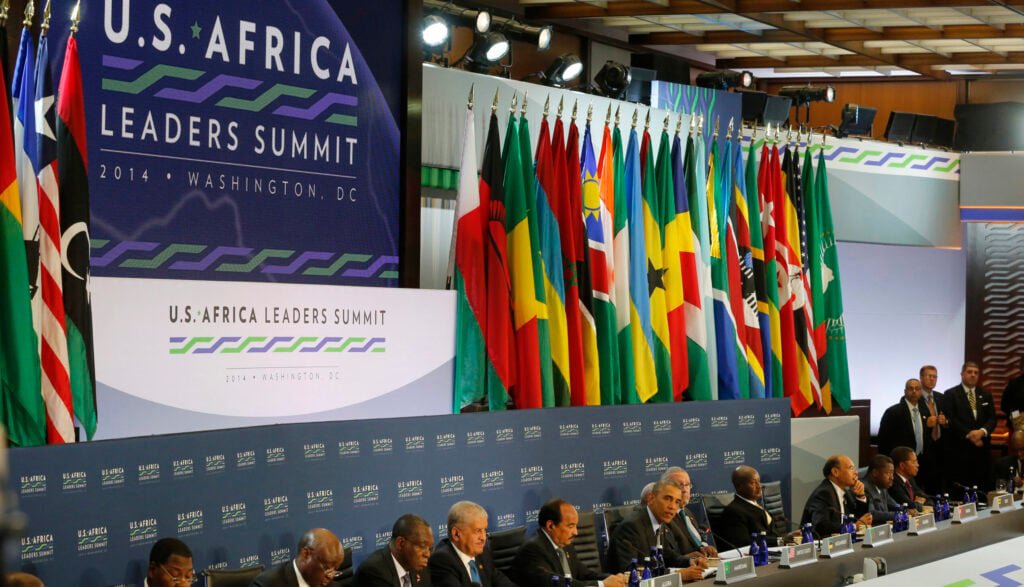
White House national security adviser Jake Sullivan on Monday also said that the administration would commit to spending $55 billion in Africa over the the next three years on “a wide range of sectors to tackle the core challenges of our time.”
“If you compare what the United States is committing over the next three years to what any other country is committing, I think we stack up extremely favorably,” Sullivan said.
And while the administration has tried to minimize concerns about China’s deepening presence on the continent as a driving force at this week’s talks, Beijing’s shadow over the biggest international gathering in Washington since the start of the pandemic nearly three years ago looms large.
Without direct mention of China, Deputy Treasury Secretary Wally Adeyemo on Monday sounded the alarm about petering private investment in middle- and low-income countries, particularly in Africa. The infrastructure finance gap, or money needed for essential projects like lighting homes and businesses, responding to the COVID pandemic and to making communities resilient against extreme weather, sits at $68 billion to $108 billion per year, Adeyemo said.
At the same time, Adeyemo lamented that huge amounts of private capital among the wealthy nations around the globe remains untapped.
“There is a clear disconnect between the large amount of available private sector capital and the urgent need to fund critical infrastructure projects in Africa and elsewhere. The question for us is: how do we connect this massive supply of savings with high-quality infrastructure projects in Africa?” Adeyemo said at the U.S. Trade and Development Agency.
Trade between the U.S. and sub-Saharan Africa was $44.9 billion last year, a 22% increase from 2019. But foreign direct investment into the region fell by 5.3% to $30.31 billion in 2021. Trade between Africa and China last year surged to $254 billion last year, up about 35% as Chinese exports increased on the continent.
The Biden administration, as it addresses criticism that Africa has remained an afterthought in U.S. foreign policy, has taken veiled jabs at China.
During his visit to Nigeria last year, Secretary of State Antony Blinken said that “too often, international infrastructure deals are opaque, coercive” and “burden countries with unmanageable debt.” The language — while tough — may have been more restrained than the Trump administration’s rhetoric; Vice President Mike Pence at the time accused Beijing of “debt diplomacy” in Africa and elsewhere.
China’s ambassador to the U.S., Qin Gang, pushed back on Monday against the Chinese debt trap notion and made the case that China has long been “sincere” in approaching Africa as the vibrant emerging market of the future.
“We are not interested in the views of any other countries on China’s role in Africa,” Qin said at the Semafor forum.
Asked whether Biden administration officials would directly approach U.S. concerns about Chinese involvement in Africa during this week’s meetings, officials bristled.
“It’s not going to be about China,” White House press secretary Karine Jean-Pierre added. “It’s going to be about Africa.”
But the Pentagon has acknowledged that China’s increasing efforts to set up military bases in Africa and forge stronger economic ties across the continent fuel U.S. security concerns that will limit how much the America’s military can work with countries that have growing ties to Beijing.
Officials said in the run-up to the meetings that while America can’t and won’t tell African countries to turn away from China, the administration is making it clear that allowing Chinese bases on their soil and using Chinese telecom systems could hurt U.S. military relations with them.
“We have a particular type of security and military and defense relationship … with African partners, and that could be jeopardized if they were to have Chinese basing in their region just because of the type of exercises, the type of work, the type of collaboration and training that we do with them,” Chidi Blyden, the deputy assistant defense secretary for African affairs, told reporters last week.
Speaking at a defense forum put on by George Washington University’s Project for Media and National Security, Blyden said the use of China’s Huawei communications network “makes it hard for us to be able to work with African partners.” She said it impacts the ability of the U.S. to communicate on a “clear and secure channel.”
The comments underscore longstanding concerns among military commanders that the U.S. must not only keep pace militarily with China in the Indo-Pacific, but in other regions of the world also. Those include Africa, South America and the Middle East, where China is eyeing military and economic expansion.
U.S. officials have also expressed concerns that China is looking to establish a military base on the western coast of Africa.
“China’s Huawei network, which is very robust across the continent, makes it hard for us to be able to work with African partners who may adopt some of these systems,” she said.
By Aamer Madhani, Lolita Baldor, contributors Seung Min Kim and Fatima Hussein
















Discussion about this post