
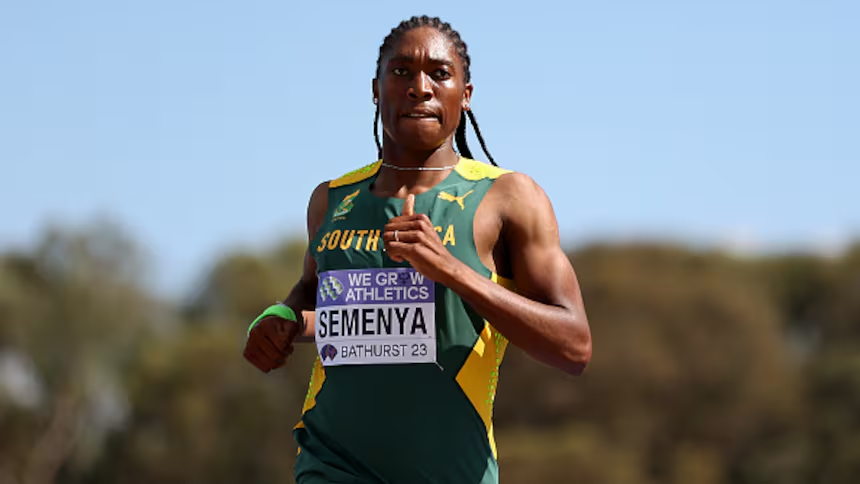
Two-time Olympic champion Caster Semenya has launched a strong criticism of International Olympic Committee president Kirsty Coventry following the governing body’s decision to exclude transgender women from female events at future Olympic Games.
The South African middle-distance runner spoke on Sunday after competing in Cape Town, responding to a newly adopted IOC eligibility framework that will apply ahead of the 2028 Los Angeles Olympics. The policy, agreed at an executive board meeting, bars transgender women athletes from competing in women’s categories and introduces tighter rules affecting athletes with differences in sex development (DSD), including Semenya herself.
Semenya, a double Olympic gold medallist in the 800m, did not hold back in her assessment of the consultation process behind the decision, accusing the IOC leadership of failing to genuinely engage affected athletes.
“For me personally, I’ll say the voice is not heard because you taking it as a tick box, you ticking a box so you can go clarify or say yes we’ve consulted. For me it’s you ticking the box. Personally for her as a leader (IOC President – Kirsty Coventry) she’s an African I’m sure she understand how you know we as Africans we coming from as a global South you know and you cannot control you know genetics. For me personally for her being a woman coming from Africa knowing how we know African women or women in the global South are affected by that.”
The IOC’s new position aligns with a broader shift in global sports governance, where federations have increasingly moved toward stricter eligibility rules in women’s competition. Prior to the 2024 Paris Olympics, several major sports — including athletics, swimming and cycling — had already introduced bans on transgender women who had undergone male puberty.
Under the revised Olympic framework, the IOC said it aims to ensure fairness in women’s sport, moving away from previous guidance that allowed individual federations to set their own standards. The policy document, published following Thursday’s meeting, outlines a unified approach designed to protect what it describes as the integrity of female competition.
Speaking in an online press conference, Coventry acknowledged the sensitivity of the issue while defending the decision. “We know that this topic is sensitive,” she said.
She added in a formal statement: “At the Olympic Games, even the smallest margins can be the difference between victory and defeat. So, it is absolutely clear that it would not be fair for biological males to compete in the female category.”
Coventry, a two-time Olympic swimming champion and the first woman to lead the IOC in its 132-year history, has made the protection of the women’s category a central pillar of her presidency since taking office. A review into the issue was among her earliest major initiatives.
However, Semenya questioned both the scientific basis and the transparency of the decision-making process, suggesting that the policy risks causing harm to athletes.
“Of course it causes harm you know bodily I’ll say and for her (IOC President – Kirsty Coventry) obviously if you say the science because we talk about science here. If the science is clear show us who decided and don’t dress that as a lie because it’s a lie and we know because we’ve seen it so if we were to answer or confront Kristy that’s how we gonna respond and we’ll respond strong as we are because it affects women.”
The ruling also has direct implications for athletes with DSD, a category that has long been at the centre of debate in track and field. Semenya, who was assigned female at birth but has naturally elevated testosterone levels, has spent years challenging eligibility regulations imposed by athletics authorities.
Her legal battle reached the European Court of Human Rights, which ruled in her favour on procedural grounds, though the decision did not overturn the underlying sporting regulations.
The IOC’s move comes amid wider political pressure around gender eligibility in sport, including policies emerging in the United States in the lead-up to Los Angeles 2028. By adopting a single framework, the Olympic body has signalled its intention to provide clarity after years of fragmented rules across different sports.