
Renewed violence in Mali is intensifying concerns about a widening security collapse across the Sahel, as fresh fighting in the northern city of Kidal coincides with coordinated nationwide attacks that have stretched government forces and exposed deep weaknesses in state control.
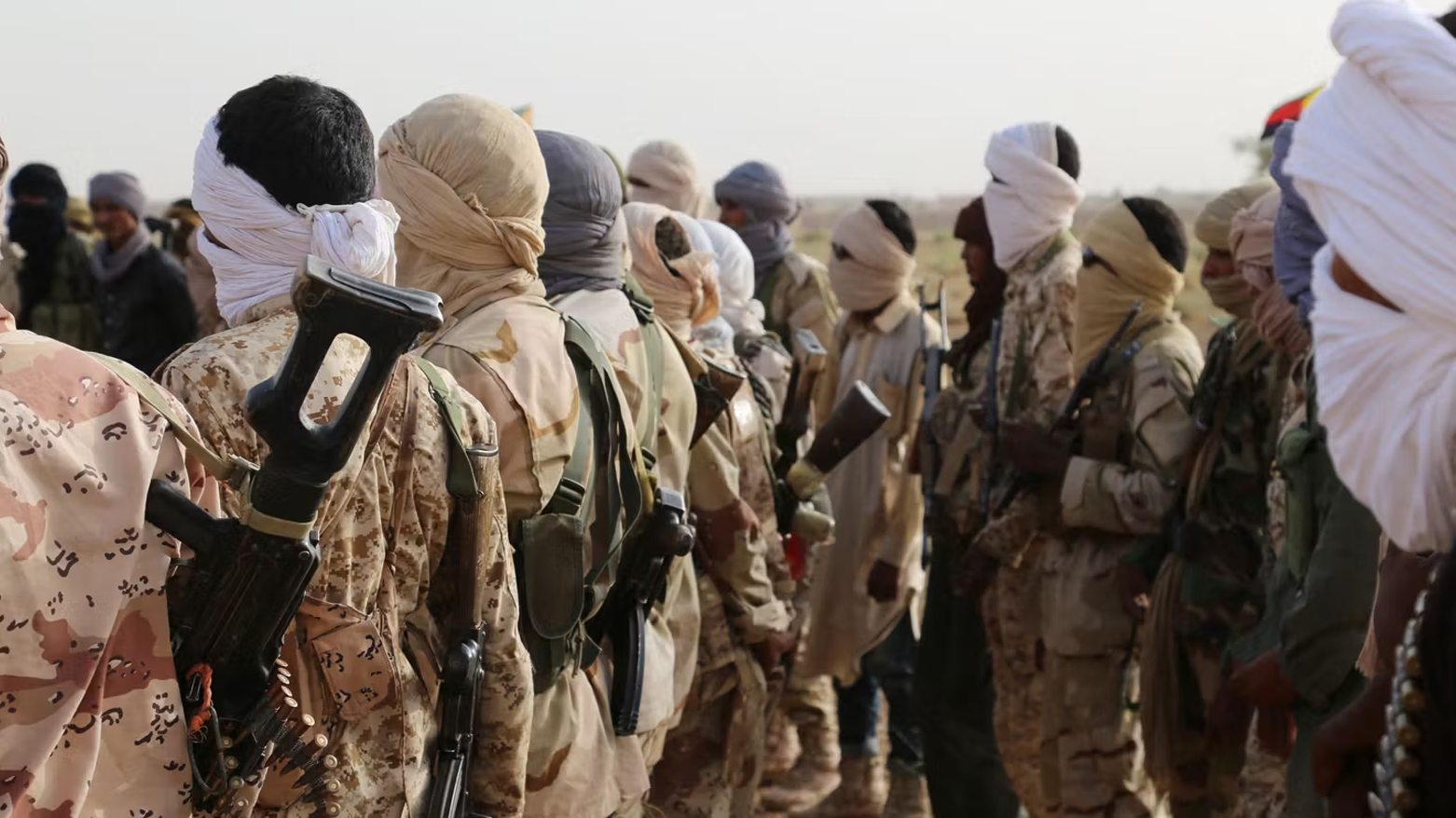
The latest clashes in Kidal involve Tuareg rebel forces and jihadist fighters confronting Malian government troops supported by Russian mercenaries. The fighting reportedly resumed shortly after rebels claimed they had taken control of the city, a long-standing flashpoint in Mali’s northern conflict. Rebel representatives said their forces were working to expel remaining government-aligned fighters, including foreign personnel who had taken refuge in military positions around the city.
Kidal has long held strategic and symbolic importance in Mali’s conflict. It is closely associated with Tuareg separatist movements that have historically sought autonomy or independence for northern territories. Control of the city has shifted repeatedly over the past decade, making it one of the most contested locations in the country. The renewed battle suggests that earlier government gains in the region remain unstable and vulnerable to reversal.
These clashes did not occur in isolation. They followed a wave of coordinated attacks across multiple regions of Mali, marking one of the most significant security escalations in recent years. Explosions, gunfire, and targeted assaults were reported in several cities, including the capital, Bamako. Military installations and infrastructure were among the reported targets, indicating a high level of planning and coordination among insurgent groups.
The attacks are believed to involve a combination of jihadist networks linked to Al-Qaeda and allied local armed factions. This growing cooperation between ideological extremist groups and regional separatist forces represents a major shift in the dynamics of the conflict. While their long-term goals are not identical, their tactical alignment on the battlefield has significantly increased their operational effectiveness.
The situation highlights how Mali’s conflict has evolved from a localized rebellion into a complex multi-actor war. The Tuareg insurgency, which initially emerged in 2012 as a movement for greater autonomy in the north, was gradually overtaken by jihadist groups exploiting instability and weak governance. Over time, overlapping grievances, territorial ambitions, and extremist ideology have created a fragmented but increasingly coordinated insurgency.
The role of Mali’s military leadership under Assimi Goïta is now under renewed scrutiny. Goïta came to power following a coup in 2020, pledging to restore security and national stability. However, the resurgence of large-scale attacks and the apparent spread of insurgent control suggest that the security situation has continued to deteriorate under his administration.
One of the key developments shaping the current crisis has been the withdrawal of international military forces. Following political tensions with Mali’s junta, French forces and United Nations peacekeepers ended their operations in the country. Their departure created a security vacuum that the government sought to fill by partnering with Russian mercenary forces, widely associated with the Wagner Group.
Although these forces have participated in combat operations alongside Malian troops, their presence has not prevented insurgent groups from regrouping and launching increasingly coordinated offensives. The latest attacks suggest that militant networks have not only maintained their capabilities but may also have strengthened their coordination and territorial reach.
Reports from the Kidal front indicate that fighting remains intense, with both sides attempting to consolidate positions. The involvement of multiple armed actors, including separatists and jihadist fighters, has further complicated the battlefield. The fluid alliances on the ground make it difficult to clearly distinguish between ideological and territorial motivations, as groups cooperate tactically despite differing long-term objectives.
The broader implications of the current escalation extend well beyond Mali’s borders. The Sahel region, including neighboring countries such as Burkina Faso and Niger, is already facing similar insurgencies fueled by weak governance, poverty, and transnational militant networks. Security analysts warn that continued instability in Mali could accelerate the spread of violence across the region.
The possibility of a regional spillover is a growing concern for international observers. The Sahel has become one of the world’s most unstable regions, with overlapping conflicts that are increasingly interconnected. If insurgent groups in Mali continue to gain ground, they could further destabilize fragile neighboring states and complicate international counterterrorism efforts.
At the center of the crisis is a long-standing failure to resolve the underlying causes of conflict in northern Mali. These include historical marginalization of Tuareg communities, disputes over political representation, and the expansion of extremist networks in remote areas where state authority is weak. Over time, these factors have created an environment in which armed groups can operate with relative freedom.
The latest wave of violence suggests that Mali is entering a more dangerous phase of its conflict. The combination of coordinated nationwide attacks, renewed urban fighting in Kidal, and increasing cooperation between jihadist and separatist forces points to an evolving and more resilient insurgency.
As the situation develops, the Malian government faces mounting pressure to reassert control and prevent further territorial losses. However, the scale and coordination of recent attacks indicate that achieving stability will be increasingly difficult without significant changes in strategy or support.
Mali now stands at a critical turning point. The outcome of the fighting in Kidal, along with the government’s ability to respond to nationwide attacks, will likely shape not only the country’s immediate future but also the broader trajectory of security across the Sahel region.