
Saturday, May 9, 2026
  • Who’sWho Africa AWARDS
  • About TimeAfrica Magazine
  • Contact Us
Time Africa Magazine
  • Home
  • Magazine
  • WHO’SWHO AWARDS
  • News
  • World News
    • US
    • UAE
    • Europe
    • UK
    • Israel-Hamas
    • Russia-Ukraine
  • Politics
  • Crime
  • Lifestyle
  • Sports
  • Column
  • Interviews
  • Special Report
No Result
View All Result
Time Africa Magazine
  • Home
  • Magazine
  • WHO’SWHO AWARDS
  • News
  • World News
    • US
    • UAE
    • Europe
    • UK
    • Israel-Hamas
    • Russia-Ukraine
  • Politics
  • Crime
  • Lifestyle
  • Sports
  • Column
  • Interviews
  • Special Report
No Result
View All Result
Time Africa Magazine
No Result
View All Result
  • Home
  • WHO’SWHO AWARDS
  • News
  • Magazine
  • World News

Home » Special Report » It’s hard to find treatment for snakebites in Kenya, As Thousands of people are dying every year

It’s hard to find treatment for snakebites in Kenya, As Thousands of people are dying every year

June 21, 2024
in Special Report
0
Share on FacebookShare on Twitter

By Zelipha Kirobi / AP

Mwingi, KENYA — Esther Kangali felt a sharp pain while on her mother’s farm in eastern Kenya. She looked down and saw a large snake coiling around her left leg. She screamed, and her mother came running.

Kangali was rushed to a nearby health center, but it lacked antivenom to treat the snake’s bite. A referral hospital had none as well. Two days later, she reached a hospital in the capital, Nairobi, where her leg was amputated due to delayed treatment.
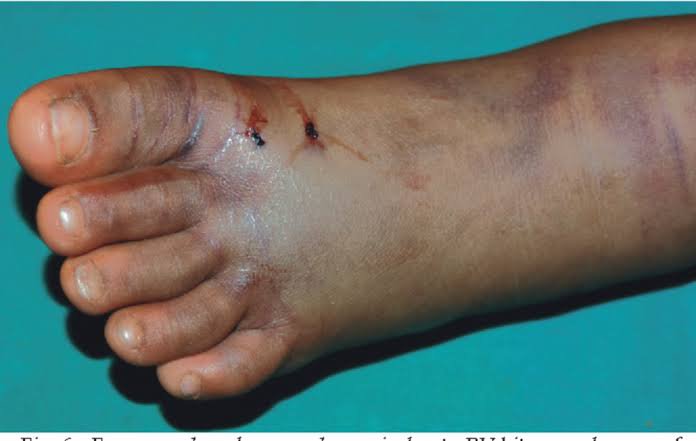
The 32-year-old mother of five knows it could have been avoided if clinics in areas where snakebites are common are stocked with antivenom.

ReadAlso

Kenyan Court Strikes Down Ruling Protecting Right to Abortion

Public attitude data are key to building resilient, competitive businesses, Afrobarometer tells private-sector leaders

Kitui County, where the Kangalis have their farm, has Kenya’s second highest number of snakebite victims, according to the health ministry, which last year put annual cases at 20,000.

Overall in Kenya, about 4,000 snakebite victims die every year while 7,000 others experience paralysis or other health complications, according to the local Institute of Primate Research.

ADVERTISEMENT

Residents fear the problem is growing. As the forests around them shrink due to logging and agricultural expansion, and as climate patterns become increasingly unpredictable, snakes are turning up around homes more frequently.

“We are causing adverse effects on their habitats like forest destruction, and eventually we are having snakes come into our homes primarily to seek for water or food, and eventually we have the conflict between humans and the snakes,” said Geoffrey Maranga, a senior herpetologist at the Kenya Snakebite Research and Intervention Center.

Climate change also can drive snakes into homesteads, he said, as they seek water in dry times and shelter in wet.

Maranga and his colleagues are part of a collaboration with the Liverpool School of Tropical Medicine to create effective and safe snakebite treatments and ultimately produce antivenom locally. Maranga’s center estimates that more than half of people bit by snakes in Kenya don’t seek hospital treatment — seeing it costly and difficult to find — and pursue traditional treatments.

Kenya imports antivenom from Mexico and India, but antivenom is usually region-specific, meaning a treatment in one region might not effectively treat snakebites in another.

Part of the work of Maranga and colleague Fredrick Angotte is extracting venom from one of Africa’s most dangerous snakes, the black mamba. The venom can help produce the next generation of antivenom.

“The current conventional antivenoms are quite old and suffer certain inherent deficiencies” such as side effects, said George Omondi, the head of the Kenya Snakebite Research and Intervention Center.

The researchers estimate the improved conventional antivenoms will take two or three years to reach the market. They estimate that Kenya will need 100,000 vials annually, but it’s not clear how that much will be produced locally.

The research aims to make antivenom more affordable to Kenyans. Even when antivenom is available, up to five vials are required, which can cost as much as $300.

Meanwhile, the research center also does community outreach on snakebite prevention, teaching health workers and others how to safely coexist with snakes, perform first aid and treat those affected by snakebite.

The goal is to have fewer Kenyans suffer like Kangali’s neighbor, Benjamin Munge, who died in 2020 four days after a snakebite because the hospital had no antivenom.

It’s unlikely that snakes will move away from homes, Kangali’s mother, Anna, said, so solving the problem is up to humans.

“If the snakebite medicine can come to the grassroots, we will all get help,” she said.

Related

Tags: KenyaSnakes
ADVERTISEMENT
Previous Post

Ultra-processed foods are killing millions — WHO report

Next Post

Macron and African leaders push for vaccines for Africa after COVID-19 exposed inequalities

You MayAlso Like

Lavinia and Michelle discovered they are half-sisters (BBC)
Special Report

How twin sisters born minutes apart discovered they had different fathers

May 2, 2026
Representative image
Special Report

Family Alleges Doctor Left Scissors Inside Woman, Days of Agony End in Death

April 26, 2026
Special Report

Tshiamiso Trust amendment could block compensation for thousands of sick and dying miners, warns Justice for Miners

April 22, 2026
Special Report

IMF Warns of Mounting Economic Pressures for Sub-Saharan Africa Amid Global Instability

April 14, 2026
Special Report

Meet The Founder Who Came To Nigeria By Chance, Saw Tomatoes Going To Waste, And Built Africa’s Most Ambitious Agribusinesses

April 12, 2026
Special Report

Fuel Crisis Drives Ethiopia to Brink, War Shock Exposes Deep Economic Fault Lines

April 12, 2026
Next Post

Macron and African leaders push for vaccines for Africa after COVID-19 exposed inequalities

The Hira Cultural District in Makkah is among the must-visit landmarks for pilgrims. (SPA)

The sacred sites in Makkah and Madinah that Hajj pilgrims have a chance to experience

Discussion about this post

World Asthma Day 2026: CIDO Foundation Provides Free Asthma Care in Delta State

How Senator Ned Nwoko Changed My Life Through His Scholarship

  • World Asthma Day 2026: CIDO Foundation Provides Free Asthma Care in Delta State

    542 shares
    Share 217 Tweet 136
  • How Senator Ned Nwoko Changed My Life Through His Scholarship

    545 shares
    Share 218 Tweet 136
  • Trending
  • Comments
  • Latest

World Asthma Day 2026: CIDO Foundation Provides Free Asthma Care in Delta State

May 6, 2026

How Senator Ned Nwoko Changed My Life Through His Scholarship

May 6, 2026

US World Cup 2026 hotel bookings lag as demand falls short of expectations

May 6, 2026

How Senator Ned Nwoko Changed My Life Through His Scholarship

May 6, 2026

World Asthma Day 2026: CIDO Foundation Provides Free Asthma Care in Delta State

May 6, 2026

Peter Obi Explains Exit from ADC

May 3, 2026

ABOUT US

Time Africa Magazine

TIMEAFRICA MAGAZINE is an African Magazine with a culture of excellence; a magazine without peer. Nearly a third of its readers hold advanced degrees and include novelists, … READ MORE >>

SECTIONS

  • Aviation
  • Column
  • Crime
  • Europe
  • Featured
  • Gallery
  • Health
  • Interviews
  • Israel-Hamas
  • Lifestyle
  • Magazine
  • Middle-East
  • News
  • Politics
  • Press Release
  • Russia-Ukraine
  • Science
  • Special Report
  • Sports
  • TV/Radio
  • UAE
  • UK
  • US
  • World News

Useful Links

  • AllAfrica
  • Channel Africa
  • El Khabar
  • The Guardian
  • Cairo Live
  • Le Republicain
  • Magazine: 9771144975608
  • Subscribe to TIMEAFRICA MAGAZINE biweekly news magazine

    Enjoy handpicked stories from around African continent,
    delivered anywhere in the world

    Subscribe

    • About TimeAfrica Magazine
    • Privacy Policy
    • Contact Us
    • WHO’SWHO AWARDS

    © Copyright TimeAfrica Magazine Limited 2026 - All rights reserved.

    No Result
    View All Result
    • WHO’SWHO AWARDS
    • Politics
    • Column
    • Interviews
    • Gallery
    • Lifestyle
    • Special Report
    • Sports
    • TV/Radio
    • Aviation
    • Health
    • Science
    • World News

    © Copyright TimeAfrica Magazine Limited 2026 - All rights reserved.

    This website uses cookies. By continuing to use this website you are giving consent to cookies being used. Visit our Privacy and Cookie Policy.