

By Francois Sennesael
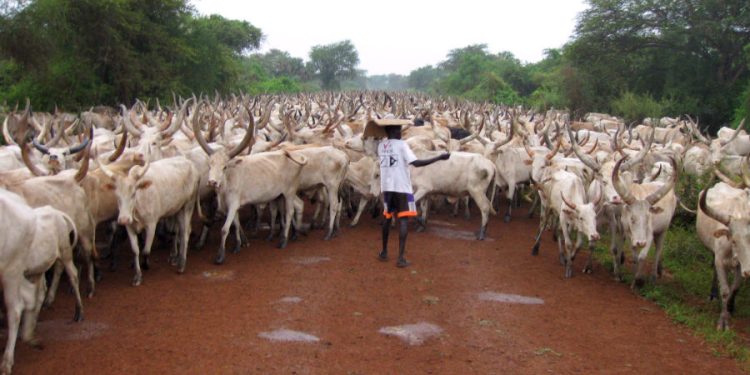
In March 2022, violent clashes between farming communities and cattle herders broke out in Eastern Equatoria State, South Sudan. It was the latest incident in months of cattle-related violence in the area, which is in the country’s southern region.
Dinka Bor herders from the neighbouring Jonglei State were pushed south into Eastern Equatoria’s Magwi County after floods submerged grazing lands. In just days, however, farmer-herder conflict displaced more than 14,000 people.
The Equatoria region hosts South Sudan’s capital, Juba. It is inhabited by more than 30 different ethnic groups, most of them farmers. It was the birthplace of the southern rebellion against Sudan’s Khartoum. Economically, it is the strongest region of South Sudan, with immense agricultural potential.
However, the militarisation of cattle raiding since the 1990s has led to frequent eruptions of violence. These raids were originally regulated by cultural authorities. But political elites have armed ethnic groups to advance their interests, leading to a proliferation of guns in the region.
Today, the presence of Dinka herders in Equatoria is used to project historical and ideological disagreements about state structure and identities in South Sudan.
As a result, what looked like local, inter-communal violence between farming host communities and displaced herders in March led to heated national debate. The Equatoria caucus in South Sudan’s Transitional National Legislative Assembly held a joint press conference to condemn the Magwi attacks.
The importance given to the Magwi conflict can be seen as the result of irreconcilable visions of the state by Equatorian and Dinka elites in South Sudan. My PhD research into Equatorian political identity traces how these visions emerged.
Equatoria as a resistance identity
More than an administrative territory, Equatoria is a context-dependent idea. It is, first, a fragile, unfinished political identity. It is used as an umbrella term to attempt to unify heterogeneous political elites coming from the colonial-era Equatoria province.
Equatorian leaders have been asking for more autonomy to run their own affairs. Its leaders feel marginalised at the national level, which is heavily tilted towards the predominant Dinka and Nuer ethnic groups.
Unlike the creation of a Kalenjin political identity in Kenya, the Equatorian political identity has struggled to become a reality. It has a weak popular base and no political party. Its more prominent leaders have been co-opted into government.
Second, for many regional elites in Juba, the term Equatoria represents a political project: federalism. These elites want to create political space for their region in the power-sharing agreement between Dinka and Nuer elites.
This was not always a priority for them.
Equatoria as a political identity emerged in the 1970s as a consequence of the perceived political marginalisation of its elites. Members of this group had previously defined themselves first as South Sudanese. They defended unity as long as they were in power.
However, they began to warn of a growing Dinka nationalism when Abel Aleir was appointed head of the autonomous region of Southern Sudan in 1972.
Equatoria as an identity of resistance gained momentum alongside the ethnicisation of politics in the 1970s. The presence of Dinka cattle herders in the predominantly farming region became the proxy through which political grievances were expressed.
The Kokora system – the redivision of Southern Sudan into three provinces at the request of Equatorian elites in 1983 – was primarily a way to expel the Dinka and their cattle from Equatoria.
My interviews in Juba found that the war against Khartoum – which was started by the Sudan People’s Liberation Movement in 1983 – is still perceived primarily as an anti-Equatoria movement led by Dinkas, rather than as a liberation movement. As a result, for Equatorian elites, the history of liberation and the roots of South Sudanese identity are contested.
Challenging central rule
Following power-sharing agreements in 2015 and 2018 after years of war, Dinka and Nuer politicians divided major political positions largely among themselves.
The Sudan People’s Liberation Movement has emphasised the importance of ‘South Sudan-ness’ to foster a sense of national unity. Claims for institutional and political autonomy from the central state are viewed as threats to the young state.
While Equatorians have been speaking of regionalism, the liberation movement has labelled it “localism” to emphasise how contrary to the idea of nation it is.
Yet Equatorians have long felt marginalised within the South Sudanese political system. They have also been blamed for trying to divide the country.
Additionally, an unsuccessful attempt to form an alliance with the Nuer in 2016 and implement a federal system gave birth to radical Equatorian factions calling for secession.
This discussion is somewhat performative in the sense that Equatorians’ ultimate ambition is not to create their own state, but rather to be included within existing structures. Yet, demands for federalism are high. Equatorian elites portray it as the only system that could liberate them from what they see as Dinka domination.
As a result, Equatorian elites have used cross-border cattle-related violence to call for a hardening of internal boundaries. It has also been used to challenge centralised power.
The defence of Equatorian farmers represents a much-needed unifying cause for a grouping divided by internal disagreements on whether to cooperate with the government or not.
The government has also been accused of arming herders to target populations that are not inclined to support its actions. This is becoming more prevalent as politicians get ready for potential elections in 2023.
The Equatorian political identity draws on existing fault lines of culture and historical memory. If the feeling of marginalisation persists, however, a strong movement could establish a community with separatist aspirations. This could endanger efforts to stabilise the world’s youngest nation.
Francois Sennesael , DPhil Candidate, Department of Politics and International Relations, University of Oxford







Discussion about this post