

By Caitlin McFall | Fox New
The massive intelligence failure in the lead up to the U.S. withdrawal from Afghanistan not only led to a chaotic evacuation, the death of 13 U.S. service members and 170 Afghans, as well as the complete Taliban takeover – it created a security vacuum that U.S. adversaries are taking advantage of.
The U.S. and its allies have seen a rise in anti-Western sentiment that has been largely spearheaded by China and Russia, who have bolstered ties in the wake of Washington’s opposition to Moscow’s war in Ukraine and Beijing’s aggressive posture in the Indo-Pacific and beyond.
However, as the U.S. looks to distance itself from its decadeslong War on Terror, adversaries like China and Russia have increasingly expanded their influence in South Asia and the Middle East.
“We don’t understand that when we turn our back to Afghanistan, and we just want to close the door and move on…we are leaving a vacuum there,” Michael Rubin, senior fellow at the American Enterprise Institute and expert on security issues in the Middle East and South Asia, told Fox News Digital. “Someone else is going to fill it.”
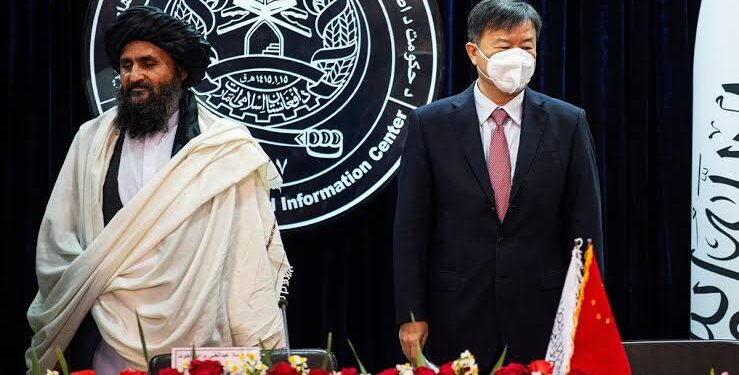
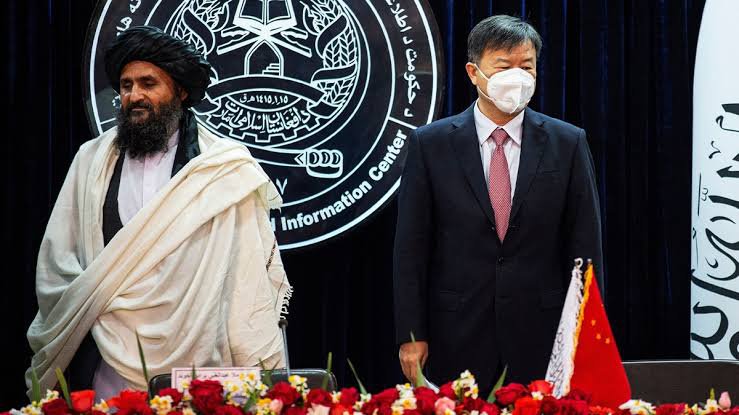
While no nation has officially recognized the Taliban as the legitimate government of Afghanistan, some nations, including the U.S.’s top adversaries, have moved forward with establishing diplomatic relations with the extremist group.
Last year, Beijing said the Taliban should not be “excluded from the international community,” and reports earlier this year suggested Moscow was considering removing the Taliban from its terrorist list – a further indication that both China and Russia are looking to use the region for their strategic aims.
Not only does the Taliban’s opposition to Western ideology play into Russian hands in spreading anti-American sentiment, Moscow is looking to expand trade with Afghanistan and other nations in the region to further alleviate economic pressure caused by Western sanctions.
Though sanctions are not the only motivating factor in expanding trade across South Asia.
The Taliban last year announced its intent to join China’s Belt and Road Initiative, and reports have suggested that Beijing is supplying the Taliban with drones, which could hamper the U.S.’s “over-the-horizon” strategy when it comes to Afghanistan.
The U.S.’s inability to foresee the Taliban takeover was not just an intelligence failure, it was indicative of a greater lapse in understanding of adversarial threats, explained Rubin.
“The other issue, which I wouldn’t call an intelligence failure, I would call it a diplomatic failure – was the refusal to address Pakistan realistically,” Rubin said.
Rubin pointed to findings one decade into the war in Afghanistan that showed 90% of the ammonium nitrate being used in Taliban roadside bombs were coming from two fertilizer factories in neighboring Pakistan.
Pakistani authorities claimed to be working with Washington in 2011 to stop smuggling efforts at a time when the U.S. was scrambling to stop al Qaeda and Taliban attacks, just months after the U.S. saw its deadliest year in Afghanistan, with the death of nearly 500 American soldiers and more than 700 coalition forces.
Though the additional discovery and subsequent assassination of al Qaeda leader and 9/11 mastermind Usama Bin Laden in May 2011, left many questioning the reliability of the Washington-Islamabad relationship – a question that remains to this day.
Pakistan has engaged in a shadow war with insurgent groups on its border with Afghanistan, but Islamabad is also suspected of having aided the Taliban through covert operations.
Despite its ambiguous security position, the U.S. continues to keep close ties with Pakistan, remaining its largest export market and a leading investor in the nation – a relationship that has not gone unnoticed by China and Russia.
Beijing has also looked to Islamabad to expand bilateral economic partnerships through its Belt and Road Initiative, particularly the China-Pakistan Economic Corridor, in which Beijing has invested some $62 billion.
Additionally, despite international pressure to walk a fine line when it comes to Russia, Pakistan has signaled it may be willing to aid Moscow in sidestepping the Western sanctions aimed at crippling its war effort through a “barter” trading system – potentially expanding an alliance that could further burden the U.S. in a region where it needs to maintain positive relations.
“It’s wrong, simply, to look at Afghanistan in isolation,” Rubin said, nodding to the root of the U.S.’s failure to assess the region’s overall state of security. “We have a tendency not to see the forest through the trees.”
A years-long probe released in 2023 showed that the collapse in U.S. intelligence spanning across the Trump and Biden administrations was rooted in Washington’s failure to correctly interpret the Afghan government’s ability to function without U.S. support.
“The Taliban were running roughshod over us, and our intelligence wasn’t picking up a thing,” Rubin said. “We were looking at Afghanistan through the lens of idealism and ideology. Here we were building a democracy. From an Afghan point of view, they were looking at it through the lens of survival.”
The expert explained that Kabul fell as quickly as it did because the Taliban had been making inroads across the nation with local governors and district chiefs for one to two years ahead of the withdrawal – meaning the fall of Afghanistan came down to momentum and defections.
“You actually had lots of families that would send one son to the Afghan National Security Forces – the army we were training – and the other son to the Taliban,” Rubin explained. “The idea wasn’t that they were favoring one power over the other, but this way if one of their family members were kidnapped at a checkpoint, they would always have someone they could call to try to get them sprung free.”
Open source intelligence also showed that the Taliban had been making gains across Afghanistan in the year leading up to the withdrawal and questions have since mounted over why neither the Trump nor the Biden administration adjusted withdrawal plans accordingly.
“Unfortunately, ego always trumps good judgment when it comes to Washington policymaking,” Rubin said. “The second issue was just exhaustion, and this notion that it was a two-decade war, the longest war in American history, and that by supporting the resistance, we would be restarting.”
“It was a persuasive argument,” he added.
Ultimately, the U.S.’s inability to understand Afghans, who lived under the constant threat of war for half a century following a coup in 1973, the Soviet-Afghan war throughout the 1980s, Taliban rule in the1990s and then the 20-year-long U.S. War on Terror, meant they did not recognize that the everyday Afghan would not fully trust that they could rely on the Afghan government without U.S. backing.
“It’s what Usama Bin Laden said,” Rubin continued, “when you have a choice between a strong horse and a weak pony…it’s natural to tie yourself to the strong horse. That’s what Afghans do.”
















Discussion about this post