
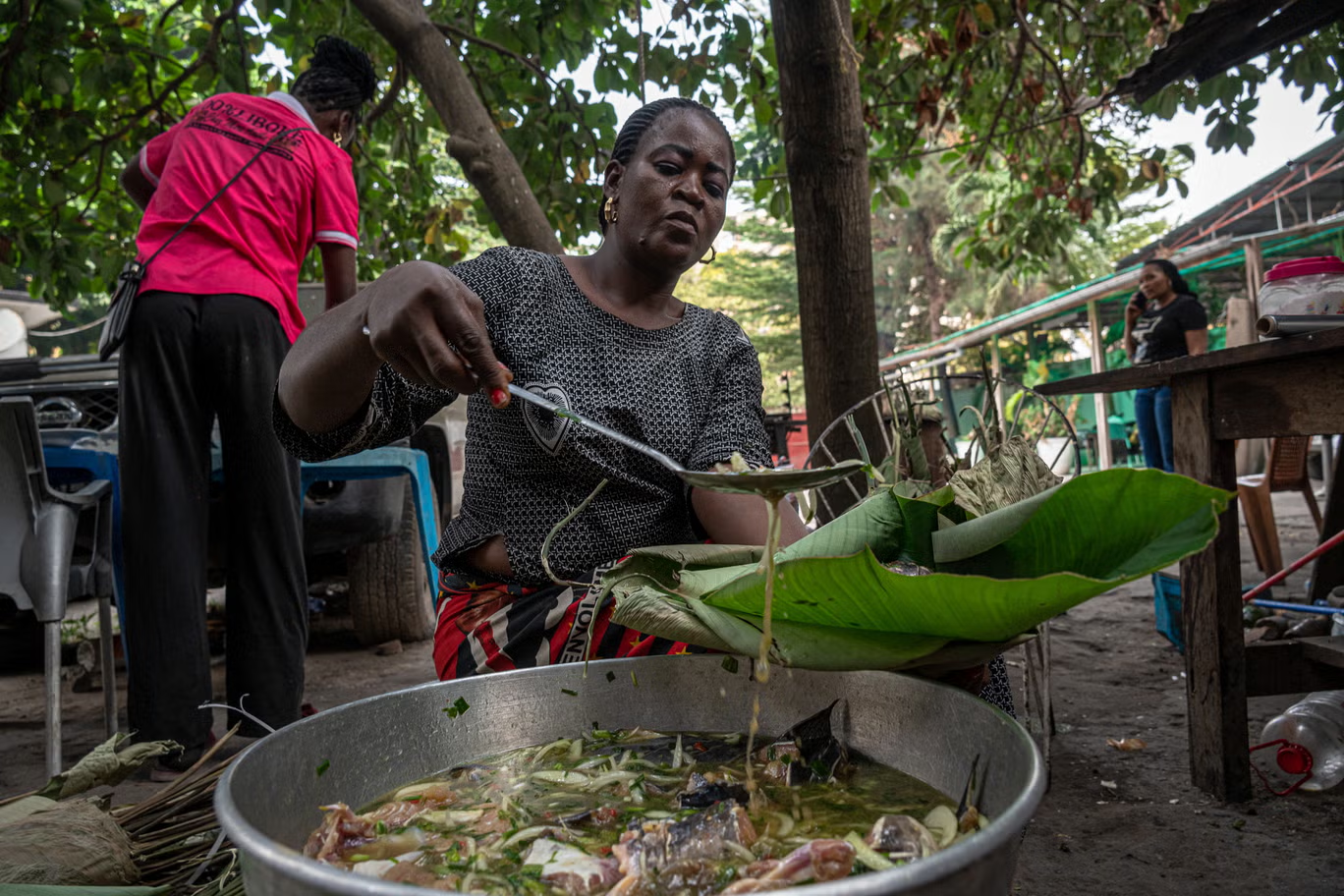
The Democratic Republic of the Congo (DRC) is sliding deeper into a hunger catastrophe, as millions of families struggle to survive amid soaring food prices, relentless conflict and collapsing economic conditions. In Kinshasa, the country’s overcrowded capital, aid workers say desperation is spreading street by street, with parents skipping meals so their children can eat and vulnerable families surviving on little more than hope.
“The suffering is everywhere,” said Régis Ngudie of Mapendo Banque Alimentaire, a food bank in Kinshasa. “Our brothers and sisters are hungry, and many people no longer know how they will feed their families tomorrow.”
For countless residents of the capital, hunger is no longer an occasional hardship but a brutal daily reality. Mothers queue for hours at markets only to leave empty-handed. Children go to sleep hungry. Elderly people survive on scraps shared by neighbors who themselves have almost nothing.
What makes the crisis even more painful, Ngudie said, is that food still exists in abundance in markets and rural farming areas. The tragedy is that millions simply cannot afford it.
“The hunger is not because there is no food,” he said. “It is because people have been crushed by poverty, by conflict, by unemployment and by a lack of protection. Food is there, but it is out of reach.”
Kinshasa, one of the fastest-growing megacities in the world, has become a symbol of both Congo’s promise and its heartbreak. The city’s population has exploded from around 3.5 million people in 1990 to nearly 18 million today, stretching already fragile public services far beyond their limits. Entire neighborhoods lack adequate sanitation, healthcare or stable electricity, while rising prices have left many families unable to buy even the most basic necessities.
Recent cuts to foreign aid have made conditions even worse, according to Ngudie, stripping away vital support just as need is intensifying.
Climate disasters have compounded the suffering. Severe flooding that struck Kinshasa in 2025 destroyed homes, swept away possessions and disrupted food deliveries across the city. In rural areas, erratic weather and poor harvests have pushed food prices sharply higher, leaving staples such as rice, cassava flour and vegetables increasingly unaffordable.
At the same time, violence in eastern Congo continues to drive one of the world’s largest displacement crises. Families fleeing armed conflict arrive in Kinshasa traumatized, exhausted and penniless, often after days or weeks of travel. Many sleep in overcrowded shelters or with relatives already struggling to survive.
“There are so many displaced families arriving here with absolutely nothing,” Ngudie said. “Some have escaped terrible violence. They come carrying children in their arms, searching for safety and food.”
Mapendo Banque Alimentaire was founded during the food shortages of the Covid-19 pandemic and now distributes donated food from supermarkets, farms and individuals to some of the city’s poorest residents. The organization also campaigns against food waste and encourages acts of solidarity within communities where survival increasingly depends on neighbors helping neighbors.
But Ngudie admits the food bank can only touch a fraction of the overwhelming need.
“Sometimes you look at the lines of people waiting and you know you cannot help everyone,” he said. “That is heartbreaking.”
The crisis has been made worse by rising global fuel and fertilizer costs, which have pushed transportation prices beyond the reach of many traders and farmers. Ngudie said the recent escalation of tensions in the Middle East, including the U.S.- and Israeli-led conflict involving Iran, has sharply increased the cost of bringing produce into Kinshasa from rural areas.
“The fuel prices have exploded,” he said. “Now fruits and vegetables arrive in the city already too expensive for ordinary people.”
Humanitarian agencies warn that the country is facing a perfect storm of overlapping crises just as international assistance is drying up.
Ibrahima Diallo, deputy country director for the United Nations World Food Programme (WFP) in the DRC, said the scale of suffering is becoming increasingly difficult to contain.
“In the DRC, the needs are rising every day while support is declining,” Diallo said. “The money available to feed people has fallen drastically.”
The DRC is one of the WFP’s largest humanitarian operations, spanning a vast country blanketed by rainforest and scarred by decades of instability. Yet despite the immense scale of need, severe funding shortages are forcing aid agencies to make agonizing decisions about who receives help and who does not.
Around five million people across the country currently require food assistance, according to the WFP, including four million in urgent need of emergency support. But because of shrinking budgets, the agency expects it will only be able to reach around one million people this year.
For many families, that gap could mean the difference between survival and starvation.
In Kinshasa, Diallo said food insecurity has become deeply entrenched. Many households survive on just one small meal a day, often lacking the nutrients children need to grow properly. Malnutrition is spreading silently through poor communities, leaving children weak, vulnerable to disease and unable to concentrate in school.
“When you walk through the city, you can see the struggle everywhere,” Diallo said. “People are exhausted. Parents are desperate. Food prices are simply too high for millions of families.”
Because resources are so limited, the WFP has been forced to concentrate much of its work in conflict-hit regions of eastern Congo, leaving few programs operating in the capital itself.
The funding crisis is also dismantling longer-term efforts designed to help communities become more resilient. Programs supporting climate-smart agriculture, improved food storage and emergency cash assistance are increasingly being sacrificed in favor of immediate survival aid.
“The danger is that people become trapped in permanent crisis,” Diallo warned. “Without investment in resilience, communities remain vulnerable to every shock.”
The worsening emergency in Congo reflects a broader global trend. The latest “Hunger Hotspots” report, published by humanitarian organizations including the WFP and the European Union, found that the number of people facing acute food insecurity worldwide has doubled over the last decade, even as international aid drops to its lowest level in years.
But behind those statistics are millions of deeply personal tragedies unfolding quietly every day in Kinshasa’s crowded streets and informal settlements.
For families there, hunger is not an abstract crisis discussed in reports or donor conferences. It is the gnawing pain of an empty stomach, the humiliation of being unable to feed a child, and the fear of not knowing whether tomorrow will bring relief or even deeper suffering.