
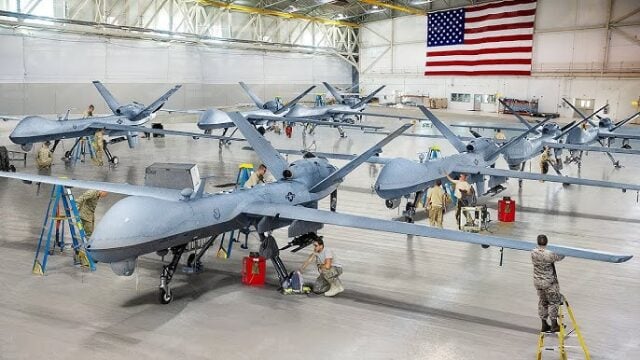
The United States has deployed armed drones and approximately 200 military personnel to Nigeria in a move that signals a deepening of security cooperation between both countries amid worsening insecurity.
The deployment is understood to focus on intelligence gathering, surveillance and training support for Nigerian forces battling insurgent groups across parts of the country, particularly in the North-East and North-West.
According to reports, the U.S. military has introduced MQ-9 Reaper drones into the operation. Although the drones are capable of carrying out precision strikes, officials indicated they are currently being used for reconnaissance and intelligence purposes rather than direct combat.
The American troops are said to be operating in an advisory capacity, providing technical support and capacity building to Nigerian security agencies. Their role does not include frontline engagement, as Nigerian authorities maintain that all combat operations remain under the control of local forces.
Military sources suggest the personnel are stationed at a strategic air facility, from where intelligence coordination and drone operations are being conducted. The collaboration is believed to be part of a broader intelligence-sharing framework aimed at improving Nigeria’s ability to detect, track and neutralise terrorist threats.
The latest development follows increasing pressure on Nigeria’s security architecture, as insurgent activities linked to Boko Haram and the Islamic State West Africa Province continue to intensify in several regions.
In recent months, attacks on military formations and civilian communities have underscored the evolving tactics and growing sophistication of armed groups. Security analysts note that insurgents are increasingly deploying coordinated assaults, advanced weaponry and, in some cases, surveillance drones.
Nigeria’s armed forces have remained stretched, contending with multiple security challenges including terrorism, banditry and communal conflicts across a vast geographical space. The addition of U.S. surveillance capabilities is expected to enhance situational awareness and improve operational response times.
This deployment also reflects a shift in U.S. counterterrorism strategy in West Africa, especially following its reduced military footprint in parts of the Sahel. With changing alliances in countries such as Mali and Niger, Nigeria is emerging as a critical partner in regional security efforts.
Although Nigerian authorities have welcomed the support, the presence of foreign military personnel has stirred debate among policy observers and civil society groups. Questions around sovereignty, operational transparency and long-term dependence on foreign assistance have been raised in some quarters.
Officials, however, insist that the arrangement respects Nigeria’s territorial integrity and command structure. They emphasise that U.S. involvement is limited to support functions and does not undermine national control over security operations.
Security experts argue that while enhanced intelligence and surveillance could deliver short-term gains, lasting peace will depend on addressing the root causes of insecurity. Issues such as poverty, unemployment, weak governance and limited state presence in vulnerable communities continue to fuel recruitment into extremist groups.
There are also concerns about the sustainability of external military assistance. Analysts warn that without parallel investments in local capacity, institutional reforms and community-based interventions, the impact of foreign support may be limited.
Nevertheless, the deployment is widely seen as a significant boost to Nigeria’s counterterrorism efforts at a time of urgent need. Improved intelligence coordination, aerial surveillance and technical expertise are expected to strengthen ongoing operations against insurgent networks.