
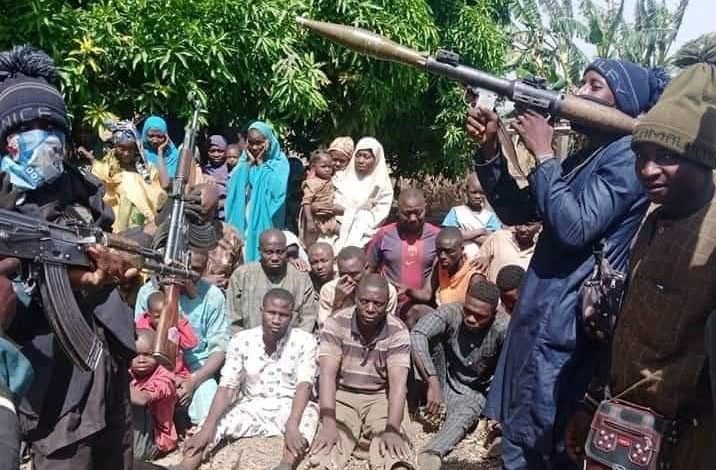
Nigeria witnessed one of its bloodiest months in recent years as terrorists and armed groups reportedly killed at least 624 people and abducted 419 others within 28 days in February, highlighting the country’s deepening security crisis.
The figures, compiled from multiple security and media reports, paint a grim picture of escalating violence across several regions of the country, including the North-West, North-Central and North-East, where communities continue to face attacks from terrorists, bandits and militant groups.
According to the report, the killings and abductions occurred in dozens of attacks on villages, highways and communities, with armed groups often arriving on motorcycles, opening fire indiscriminately, burning homes and taking residents hostage.
Security analysts say the violence cut across several states including Zamfara, Kaduna, Niger, Kwara, Benue and Borno, where insurgents and bandits continue to exploit weak security presence in rural areas.
One of the most devastating incidents during the month occurred in Kwara State, where hundreds of terrorists stormed the villages of Woro and Nuku in early February. During the massacre, gunmen reportedly surrounded the communities, blocked escape routes and began attacking residents door-to-door. The assault left at least 162 people dead, though some reports later suggested the toll could have risen to over 200 as more bodies were discovered in surrounding bushes.
Eyewitnesses said the attackers set homes ablaze, executed villagers and abducted several residents during the raid. The attackers were heavily armed and operated in large numbers, moving through the communities for hours. Local authorities said the militants launched the attack after residents refused their demand to adopt an extremist interpretation of Sharia law.
In another deadly incident in northwestern Nigeria, armed men riding motorcycles attacked communities in Zamfara State, killing dozens of villagers in a single night. A local lawmaker reported that the gunmen moved from one village to another, leaving at least 50 people dead while several others were abducted or declared missing.
Residents said they had earlier warned authorities after spotting more than 150 motorcycles carrying armed men, but security forces reportedly failed to respond before the attack was launched.
Alongside the killings, kidnappings remained a major threat throughout the month. The report states that 419 people were abducted within the same 28-day period, with many victims taken from villages, churches, highways and residential areas. Armed groups increasingly rely on kidnapping as a major source of revenue, demanding ransom payments from families and communities.
In Kaduna State, gunmen attacked Kauru village in the early hours of February 7, killing three people and kidnapping eleven others, including a Catholic priest. Such attacks have become frequent in parts of northern Nigeria, where rural communities often lack adequate security protection.
Security experts warn that Nigeria’s security crisis is becoming more complex as multiple armed groups operate simultaneously. The country faces threats from several factions including Boko Haram, the Islamic State West Africa Province (ISWAP), armed bandit gangs and local militias. Many of these groups exploit poverty, weak governance and porous borders to recruit fighters and carry out attacks.
The insurgency linked to Boko Haram, which began in 2009, has already claimed thousands of lives and displaced millions of people across Nigeria’s northeast and neighboring countries. However, analysts say violence is now spreading beyond the traditional conflict zones into other regions, particularly the North-Central belt, once regarded as relatively stable.
For residents of affected areas, daily life has become increasingly dangerous. Farmers have abandoned their fields, markets have been deserted and many families have fled their homes to safer towns. Survivors of recent attacks described scenes of chaos as armed men stormed their communities at night, firing indiscriminately and burning houses.
Humanitarian groups say the growing wave of violence is also worsening Nigeria’s already severe displacement crisis, with thousands forced to live in camps or seek shelter with relatives.
In response to the escalating violence, Nigerian authorities have promised stronger military operations against terrorist groups. Following the February massacre in Kwara State, President Bola Tinubu ordered the deployment of additional troops and launched a military initiative aimed at strengthening security in vulnerable communities.
Security agencies have also intensified intelligence gathering and joint operations in several states to dismantle criminal networks responsible for kidnappings and mass killings.
Despite these efforts, civil society groups and security experts argue that Nigeria needs a more comprehensive strategy to address the crisis. They say stronger intelligence coordination, improved policing in rural areas and better economic opportunities for young people are critical to reducing recruitment by armed groups.
Human rights organizations have also urged the government to improve protection for civilians and ensure accountability for those responsible for mass atrocities.