
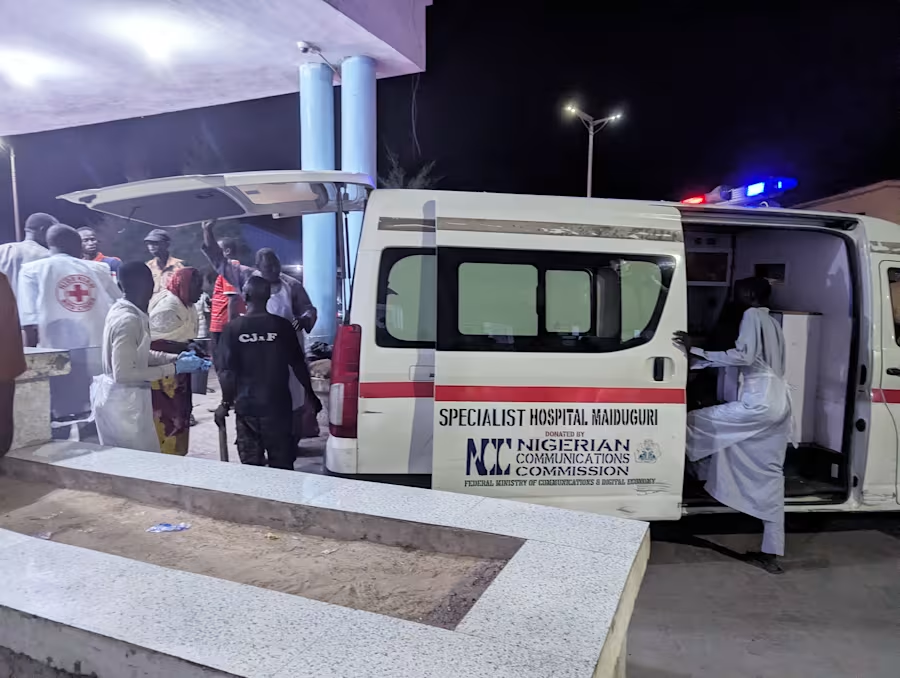
Maiduguri — Multiple coordinated suicide bomb attacks in the northeastern Nigerian city of Maiduguri have killed at least 23 people and injured more than 100, marking a dramatic return of large‑scale violence to a city that had enjoyed a period of relative calm.
The blasts on Monday evening (March 16) struck at least three crowded locations nearly simultaneously — including the entrance to the University of Maiduguri Teaching Hospital, the bustling Monday Market, and the Post Office business district. Police believe the explosions were carried out by suspected suicide bombers, although no armed group has formally claimed responsibility.
Eyewitness accounts paint a harrowing picture of chaos and terror as the blasts shook the city.
“We were sitting when we suddenly heard a loud explosion [BOOM],” said Modu Bukar, a resident. “Everyone immediately started running in fear. As we ran, people kept shouting that we should keep going. Later, we learned that the other explosion near the Post Office was also caused by a man carrying a bomb. While people were still fleeing, another explosion occurred around the Post Office area.”
As panic spread, ordinary residents became de facto first responders, rushing the wounded to nearby medical facilities, including the University Teaching Hospital, the General Hospital, and Umaru Shehu Hospital, Bukar added. “However, the number of people injured and those who died was so large that we cannot even estimate the exact figure.”
Another witness, Mala Mohammed, described harrowing scenes at the blast sites: “From what I personally saw with my own eyes, there were at least ten bodies on the ground. Honestly, I did not count them one by one because I could not bear to do so. But there were many dead, and the number of injured people was even higher.”
Official casualty figures continue to be refined, but preliminary reports from police and emergency responders suggest at least 23 fatalities and 108 injuries, including both civilians and members of the emergency services.
Some hospital sources have said that over 200 wounded people were brought into emergency wards as the night unfolded, with some reportedly dying before treatment could be administered. The scale of the incident has overwhelmed local medical facilities, with urgent appeals for blood donations and additional medical support issued by health workers.
Maiduguri, the capital of Borno State, has long been synonymous with Nigeria’s brutal Islamist insurgency. For nearly two decades, the extremist group Boko Haram and its offshoot, the Islamic State West Africa Province (ISWAP), have waged a campaign of violence across the Lake Chad region, killing thousands, displacing millions, and redefining life in the country’s northeast.
In recent years, Maiduguri — once the epicentre of daily shootings, roadside bombs, and mass casualty attacks — had seen a notable reduction in high‑profile attacks, as Nigerian security forces and international partners pushed militants increasingly into rural strongholds. This respite, however fragile, had given residents hope that the worst era of urban terror was receding. That fragile calm now appears to be unraveling.
The bombings in Maiduguri come amid a wider escalation of militant activity across Borno State and Nigeria’s northeast. In the days preceding the explosions, the Nigerian army reported repelling a major assault by suspected insurgent fighters on the outskirts of Maiduguri, a move some analysts say may have been designed to distract security forces ahead of the urban bombings.
Just days earlier, at least 65 Nigerian soldiers were reportedly killed in coordinated jihadist raids elsewhere in Borno, in what has been described as one of the deadliest stretches of insurgent violence in recent months. Such attacks underscore the persistent threat posed by Islamist militants, even as military offensives and international support have aimed to weaken insurgent capabilities.
In response to the bombings, Nigerian authorities have launched investigations and mobilised security forces across Maiduguri to secure key infrastructure and prevent further attacks. Police have urged residents to stay away from affected areas as clearance operations and forensic examinations continue.
Heavy patrols and checkpoints have been reported across the city, with the military and police stepping up vigilance in public spaces. Governor Babagana Zulum, currently abroad, condemned the attacks in the strongest possible terms, describing them as “barbaric, cruel and cowardly” acts targeting innocent civilians.
For the people of Maiduguri, the psychological impact of this sudden return to mass violence is profound. Many residents had begun to rebuild their lives after years of displacement and insecurity. Schools reopened, markets thrived, and somewhat normal everyday routines returned. But the echoes of Monday’s blasts — and the sight of bodies strewn near market stalls, hospitals overflowing with the wounded — have abruptly shattered that sense of safety.
Families now mourn lost loved ones, while survivors grapple with physical and emotional injuries. Humanitarian organisations and local volunteer groups are working to help affected families, distribute aid, and support trauma counselling, but resources in this impoverished region are limited.
No insurgent organisation has yet claimed responsibility for the bombings. However, both Boko Haram and ISWAP have a long history of using suicide bombers to strike soft targets such as markets and public spaces — tactics that became tragically familiar in Maiduguri’s worst years of insurgency.
Analysts note that the sophistication and coordination of the attacks — simultaneous explosions in three vulnerable locations — suggests a high degree of operational planning and organisation.
The attacks are likely to intensify pressure on the Nigerian government to bolster counter‑terror operations and address the security vacuum that militants have exploited. International partners and regional neighbours have increased security cooperation in recent years, but Monday’s bombings demonstrate that, even after sustained military efforts, the core challenge of insurgency in Nigeria’s northeast remains far from resolved.
As casualties continue to be treated and investigations proceed, Maiduguri’s residents are left to confront an unsettling reality: a city once thought to be moving beyond the worst of its conflict may again be at the centre of Nigeria’s long, painful struggle against extremist violence.
The human cost — measured not just in lives lost and limbs maimed, but in shattered confidence and deep trauma — will resonate far beyond the streets of this troubled city. The question now facing authorities and civilians alike is whether Maiduguri’s fragile peace can be restored, or if the spectre of insurgency will tighten its grip once more.
Timeline of Recent Insurgent Activity in Borno State (2025–2026)
September – October 2025
- Coordinated ISWAP attacks on communities: Fighters reportedly launched simultaneous assaults on several communities in Borno’s LGAs including Mafa, Dikwa, Marte, and Ajiri, causing civilians to flee their homes and prompting defensive operations by troops. Local sources said insurgents arrived heavily armed, riding motorcycles and gun trucks into the communities.
Late 2025
- Battle of Lake Chad (Nov 5–8): Jihadist factions, including Boko Haram elements, clashed over territorial control around Lake Chad. The fighting resulted in significant casualties and highlighted ongoing rivalries among armed groups operating in Borno’s waterways and islands.
January 9–22, 2026
- Military clearance operations: Nigerian troops intensified operations under Operation Hadin Kai, targeting insurgent bases in the Bulaagalda, Dagumba, Bonne, Yaganari and other rural clusters. Reports indicated destruction of camps and surrender of insurgents, with weapons and supplies seized.
- Boko Haram vs. ISWAP faction clash: Fierce fighting erupted between two jihadist factions near Dogon Chiku Buhari village, inflicting heavy casualties on both sides. The ongoing internecine violence underscores the shifting dynamics among extremist groups.
Early March 2026
- Major jihadist raids: Insurgents were reported to have overrun several military bases in Borno, killing dozens of Nigerian soldiers and abducting civilians. These coordinated assaults represented one of the deadliest phases of violence in recent months and highlighted militants’ growing operational daring.
- Troops repel attacks on bases (March 13): Nigerian forces reported repelling coordinated attacks on troop positions at Banki and Azir, killing several insurgents and recovering arms, though such clashes affirmed sustained militant pressure in the region.
March 16–17, 2026
- Maiduguri bombings: Multiple suspected suicide bomb explosions rocked Maiduguri’s main market, post office area and near the University of Maiduguri Teaching Hospital, killing at least 23 people and injuring over 100 in what many see as a dramatic return of urban terror in an area that had seen relative calm.
- These bombings followed recent militant actions on the city’s outskirts, suggesting insurgents may be shifting tactics toward bold urban attacks after prolonged rural engagements. Heavy security deployments and investigations are underway.