
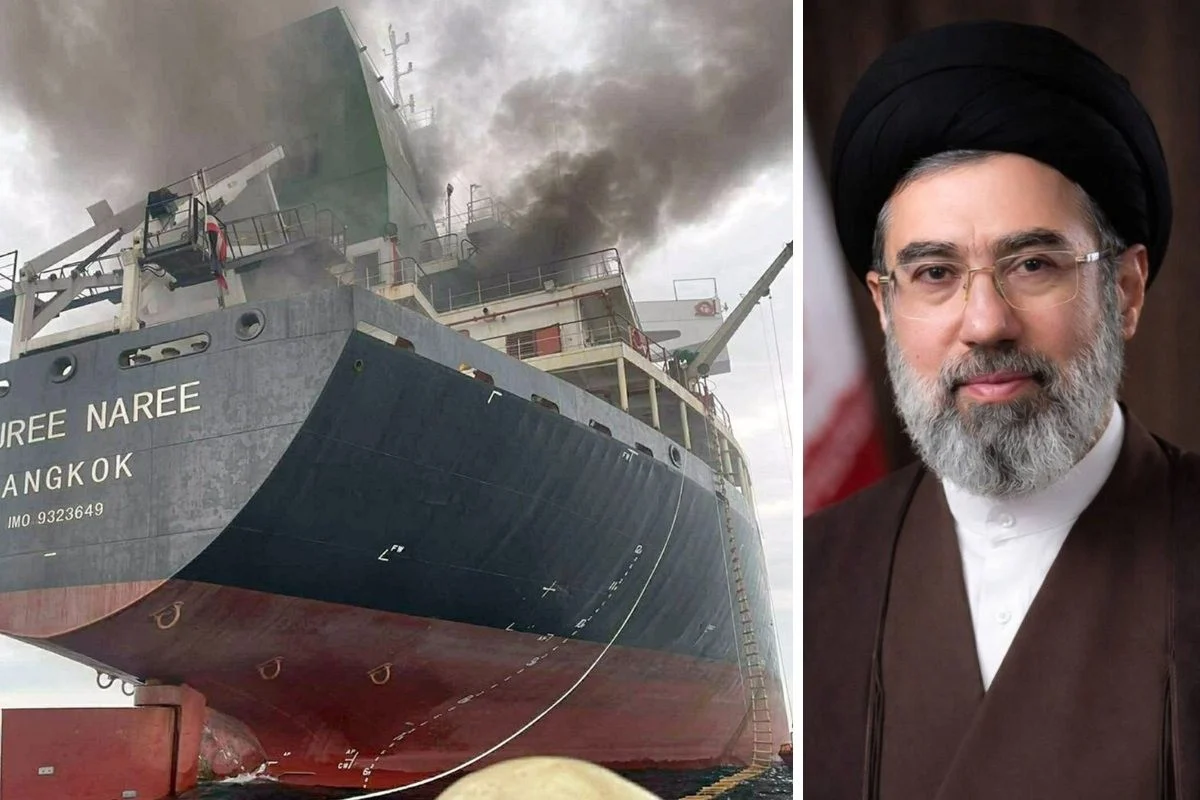
Iran’s new supreme leader, Mojtaba Khamenei, has vowed that the strategically vital Strait of Hormuz will remain blocked and warned that American military bases across the Middle East could face further attacks, in his first public statement since succeeding his father.
The message, broadcast by Iranian state television on Thursday, marked the first official words attributed to the 56-year-old cleric since the death of his father, Ali Khamenei, who was killed in an airstrike amid a widening regional conflict involving the United States and Israel.
“The lever of blocking the Strait of Hormuz must definitely be used,” Mojtaba Khamenei said in the statement, describing the closure of the narrow waterway as a strategic tool to pressure Iran’s adversaries.
The declaration signals a continuation – and potentially an escalation – of Iran’s confrontational posture at a moment when tensions in the Middle East have already disrupted global energy markets and heightened fears of a broader regional war.
Khamenei’s statement included a direct warning to governments across the Gulf region that host American forces. He urged neighbouring states to shut down US military bases immediately, warning that they would otherwise remain targets.
“Our neighbours in the region must close the American bases on their soil as soon as possible,” he said, arguing that Washington’s promise to provide security to its partners had proven false.
“The claim of establishing security and peace by America was nothing more than a lie.”
The remarks were accompanied by a broader warning that Iranian forces and allied groups could expand attacks on US facilities in the region. Since the outbreak of the latest hostilities, several American installations and allied infrastructure have already been targeted by missiles and drones as part of a growing shadow conflict stretching across the Middle East.
Khamenei also vowed that Iran would continue retaliating for those killed during the war.
“I assure everyone that we will not neglect avenging the blood of your martyrs,” he said, referencing the deaths of Iranian officials, soldiers and civilians in recent strikes.
At the centre of Khamenei’s message was the future of the Strait of Hormuz, one of the most critical maritime chokepoints in the global economy.
Roughly a fifth of the world’s oil supply normally passes through the narrow channel between Iran and the Arabian Peninsula. In recent weeks, however, shipping traffic has plunged amid missile attacks, naval skirmishes and growing fears of escalation.
By insisting that the waterway remain effectively closed, the new supreme leader signalled that Tehran intends to use global energy supply as leverage in its confrontation with Washington and its allies.
Analysts say the decision reflects Iran’s longstanding strategic doctrine: if it cannot export oil freely under sanctions or wartime conditions, it will prevent others from doing so as well.
Oil markets have already reacted nervously to the prospect of a prolonged shutdown. Crude prices surged above $100 a barrel earlier this week amid fears that a sustained disruption could trigger one of the largest supply shocks in decades.
The statement also offered the clearest indication yet of how Mojtaba Khamenei intends to lead Iran following the death of his father, who ruled the Islamic republic for more than three decades.
He was chosen earlier this month by the Assembly of Experts, the clerical body responsible for selecting Iran’s supreme leader. His appointment ended days of uncertainty after the airstrike that killed Ali Khamenei during the intensifying conflict with the US and Israel.
The succession was controversial even before the war. Mojtaba Khamenei had long been considered a powerful figure behind the scenes in Tehran, wielding influence within the country’s security apparatus and maintaining close ties with the Islamic Revolutionary Guard Corps.
Critics, including some within Iran’s clerical establishment, had raised concerns about what appeared to be a dynastic transfer of power in a political system that emerged from a revolution against monarchy.
Nonetheless, the swift endorsement of the new leader by Iran’s political and military leadership suggested that the country’s ruling elite had rallied behind him amid the external threat.
Khamenei also praised Iran’s network of regional allies, often described collectively by Tehran as the “axis of resistance”.
He cited militant groups across the region – including those in Lebanon, Yemen and Iraq – as partners in confronting Israel and the United States. Fighters from allied movements in those countries have already launched attacks during the conflict, including missile strikes and assaults on shipping routes.
Iranian officials have repeatedly suggested that additional fronts could be opened if the war continues, raising fears of an expanding conflict that could engulf much of the Middle East.
Despite the defiant tone of the statement, uncertainty remains about the new supreme leader himself.
The message was read on state television by a news anchor rather than delivered personally by Mojtaba Khamenei, and he has not yet appeared publicly since his father’s death. The absence has fuelled speculation about his location following the airstrike that killed members of his family.
Iranian officials have not addressed those rumours, instead emphasising national unity and the need to continue resisting what they describe as foreign aggression.
Khamenei’s remarks are likely to deepen concerns in Western capitals and energy markets that the conflict is entering a more dangerous phase.
The United States has already conducted thousands of strikes against Iranian-linked targets across the region, while Israel has continued military operations aimed at weakening Iran’s nuclear and missile capabilities.
For Gulf states, the threat against US bases places them in an increasingly precarious position. Countries across the Persian Gulf host American military facilities while also relying heavily on stable maritime trade routes through the region.
A prolonged closure of the Strait of Hormuz could therefore have sweeping consequences not only for the Middle East but for the global economy.
For now, Mojtaba Khamenei’s first message as Iran’s supreme leader offers little sign of compromise.
Instead, the tone of his statement suggests that the Islamic republic intends to confront its adversaries directly and use every available lever – military, economic and strategic – to do so.
Whether that strategy will deter further attacks or push the region closer to a broader war remains one of the most urgent questions facing the international community.