
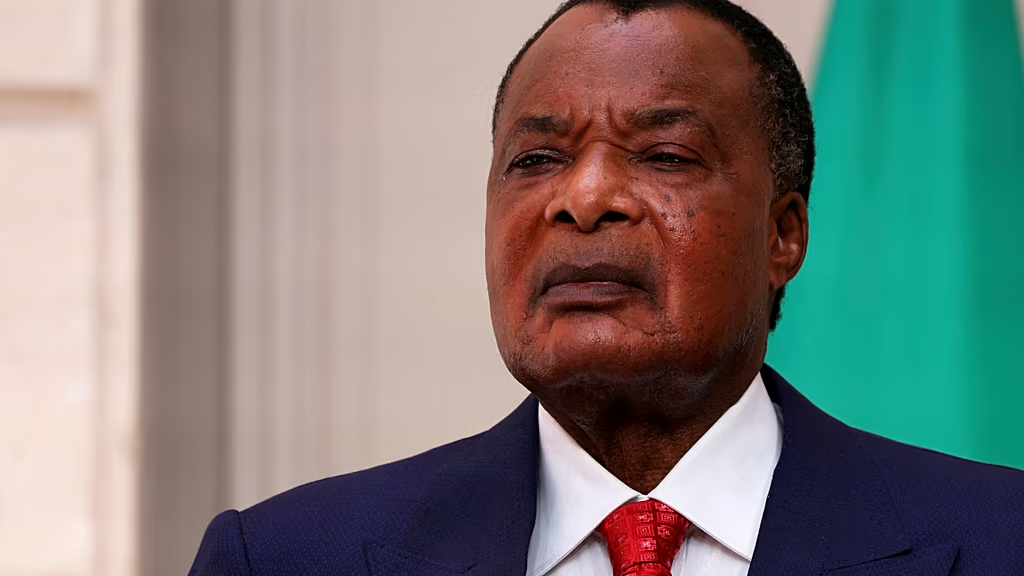
People in the Republic of the Congo are voting on Sunday in a presidential election widely expected to extend the decades-long rule of incumbent president Denis Sassou Nguesso, one of Africa’s longest-serving leaders. The 82-year-old head of state is seeking a fifth consecutive term in power, which would further cement his influence over the oil-rich Central African nation after more than four decades at the helm.
About three million voters are registered to participate in the election, though analysts say turnout may be historically low due to opposition boycotts, political repression, and widespread skepticism about whether the vote will produce meaningful change. If no candidate wins an outright majority, a second round could theoretically be held three weeks later, though Sassou Nguesso is widely expected to win outright in the first round.
A political system dominated by one leader
Sassou Nguesso has been a dominant figure in Congolese politics since he first came to power in 1979 under a Marxist-leaning one-party system led by the Congolese Workers’ Party. He lost power briefly after multiparty elections in 1992 but returned in 1997 following a civil war that toppled the government of then-president Pascal Lissouba.
Since reclaiming power, Sassou Nguesso has won presidential elections in 2002, 2009, 2016 and 2021, though opposition groups and international observers have frequently criticized the polls as lacking transparency and fairness.
In the current election, six candidates are running against him. However, the opposition is deeply fragmented and weakened. Two prominent figures from previous elections — Jean‑Marie Michel Mokoko and André Okombi Salissa — are serving long prison sentences after being convicted of threatening national security, charges their supporters say are politically motivated.
Other opposition leaders remain in exile, while several parties have chosen to boycott the vote entirely, arguing that the electoral process is heavily controlled by the government.
As a result, many analysts believe the election is unlikely to pose a serious challenge to the incumbent’s grip on power.
Security and stability as campaign themes
During the campaign, Sassou Nguesso emphasized stability and security, themes that have long been central to his political messaging. Speaking at his final campaign rally in the capital Brazzaville, he urged citizens to participate in the vote and warned that maintaining peace in the country requires continuity in leadership.
Supporters argue that the president has helped stabilize Congo after years of political turmoil and civil conflict in the 1990s. His government has also pursued infrastructure projects and development initiatives aimed at modernizing the country’s economy.
However, human rights organizations and civil society groups frequently accuse the government of restricting political freedoms, suppressing dissent and targeting activists.
Oil wealth and economic realities
Despite significant natural resources, the Republic of Congo remains one of the poorer countries in Africa. The economy relies heavily on oil and gas exports, which account for more than three-quarters of the country’s export earnings. The country is among the largest oil producers in sub-Saharan Africa, but its economic model has long been criticized as overly dependent on hydrocarbons.
Economic growth has resumed in recent years after a prolonged downturn. Real GDP grew by about 2.6% in 2024 and is projected to reach roughly 2.8–3% in 2025, driven largely by the energy sector and modest expansion in manufacturing and agriculture.
However, the benefits of this growth have not been evenly distributed. More than half of the population lives in poverty, and unemployment — especially among young people — remains high.
According to economic reports, nearly half of Congolese citizens live on less than about $2.15 per day. Meanwhile, a large portion of the workforce operates in the informal economy, limiting the government’s ability to generate tax revenue and create stable employment.
The country also faces structural challenges such as limited infrastructure, unreliable electricity, and weak access to finance for businesses. These factors make it difficult for private companies to expand and create jobs.
Corruption allegations and governance concerns
Critics argue that Congo’s economic struggles are partly linked to governance problems. Activists and opposition figures have long accused senior officials of diverting oil revenues and state funds into private accounts.
Several investigations into alleged corruption and money laundering linked to Congolese officials have been launched in France and other countries. These investigations have fueled debates about how much of the country’s oil wealth actually benefits ordinary citizens.
The government denies wrongdoing and says it is implementing reforms aimed at improving transparency, reducing public debt and diversifying the economy.
Efforts to diversify the economy
Recognizing the risks of oil dependency, Congolese authorities have promoted diversification strategies in sectors such as agriculture, forestry, and natural gas.
The country possesses vast forests covering roughly two-thirds of its territory, making it one of the most forest-rich nations in the world and a key player in global climate and conservation discussions. Sustainable forestry and carbon-credit initiatives are increasingly seen as potential sources of revenue.
Agriculture is another area with significant potential. The government hopes to expand domestic food production and reduce reliance on imports while building agro-processing industries that could create jobs.
Still, experts say meaningful diversification will require deeper reforms, improved governance, and stronger institutions.
International relations and global image
Historically, the Republic of Congo has maintained close diplomatic and economic ties with France, its former colonial ruler. French companies have long played a major role in the country’s oil and infrastructure sectors.
At the same time, the government has cultivated relations with Russia, particularly in the areas of security and military cooperation.
More recently, the country has also expanded partnerships with emerging powers such as China, which has financed several infrastructure projects across the country.
These international relationships help sustain Congo’s economy but also shape its geopolitical positioning in Central Africa.
The question of succession
Although Sassou Nguesso appears likely to win the current election, attention is increasingly shifting toward the question of succession.
Under the current constitution, he cannot run again in 2031, which means the coming years could determine who eventually inherits the political system he built.
Some analysts speculate that members of his inner circle — including relatives or long-time political allies — may emerge as potential successors. However, the president has not publicly named a preferred candidate.
For many Congolese citizens, the bigger question remains whether the country will eventually see a genuine democratic transition after decades of rule dominated by a single political figure.