
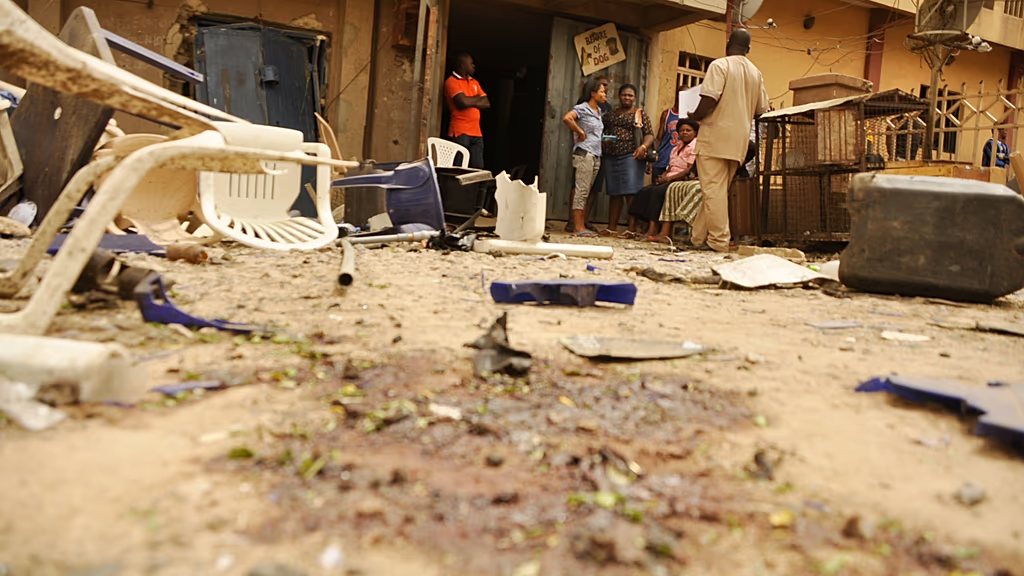
Gunmen have killed at least 33 people after opening fire on a bar in Jos, the capital of Nigeria’s Plateau state, in an attack that triggered reprisal violence and prompted authorities to impose a curfew.
The assault took place on Sunday evening in the Anguwan Rukuba area of Jos North, a densely populated district that has seen intermittent unrest but relatively fewer large-scale attacks in recent years. Witnesses said unidentified assailants stormed a bar and restaurant, shooting indiscriminately at patrons before turning their weapons on people outside the premises.
Eyewitnesses described scenes of chaos and panic as the attackers fired at anyone in sight. “They were not only shooting inside the bar,” said one resident who lives nearby. “They shot at everyone outside too – people passing on the road, traders, anyone they saw moving. People were running in all directions.”
Another survivor said the gunmen arrived suddenly and began firing without warning. “At first we thought it was a fight, then we heard continuous gunshots,” he said. “Those who tried to escape were also targeted. Some people fell on the road while trying to run.”
Initial reports suggested that around 12 people were killed in the shooting. However, the death toll rose sharply to at least 33 as violence spread, with additional fatalities recorded during retaliatory attacks by a mob in the aftermath.
Local sources said the attackers appeared to deliberately target civilians gathered at the venue. In the confusion that followed, a group of youths reportedly mobilised and began attacking passersby and nearby traders, accusing them of links to the gunmen. At least three people were killed during the reprisals, some of them burned, according to community leaders.
A local youth leader said anger quickly spiralled out of control. “People were furious and confused. Instead of waiting for security forces, some took the law into their own hands,” he said. “That made the situation worse.”
Authorities in Plateau state confirmed the outbreak of violence and announced a curfew in Jos North in an attempt to prevent further escalation. Security forces have since been deployed across key flashpoints, while an investigation into the identity and motive of the attackers is under way.
The violence has also disrupted daily life in the city. The University of Jos postponed examinations amid fears of further unrest, while residents were urged to remain indoors.
Although no group has claimed responsibility for the attack, the incident reflects a broader pattern of insecurity in Nigeria’s Middle Belt region. Plateau state has long been a flashpoint for communal violence, particularly in rural areas where disputes over land and grazing rights frequently erupt between predominantly Christian farming communities and mostly Muslim Fulani herders.
Analysts say such conflicts have become increasingly complex, driven not only by ethnic and religious tensions but also by environmental pressures and weak governance. Climate change and desertification in northern Nigeria have pushed herders southwards in search of pasture, intensifying competition over land. Rapid population growth has further strained resources, while limited law enforcement capacity has often allowed cycles of retaliation to continue unchecked.
While Jos experienced devastating sectarian clashes in the late 2000s, including violence that left hundreds dead, the city had seen a relative lull in large-scale urban attacks in recent years. Sunday’s assault has therefore raised concerns about a possible resurgence of coordinated violence within the city.
Civil society groups and community leaders have called for calm, warning that misinformation circulating on social media risks inflaming tensions further. Conflicting narratives about the identity of the attackers have already begun to emerge, with some attributing the violence to armed herder militias and others suggesting the involvement of criminal gangs.
Security analysts caution that such ambiguity is typical in Plateau state, where overlapping conflicts – including banditry, communal disputes and organised crime – often blur clear lines of responsibility.
For residents of Jos, the trauma remains immediate. “We have never seen anything like this in this area for a long time,” said one shopkeeper. “People are afraid. Nobody knows who could be targeted next.”
The Nigerian government has repeatedly pledged to restore stability to the region, but critics argue that responses have been reactive rather than preventative. Without sustained efforts to address underlying grievances and improve security coordination, they warn, cycles of violence are likely to persist.