
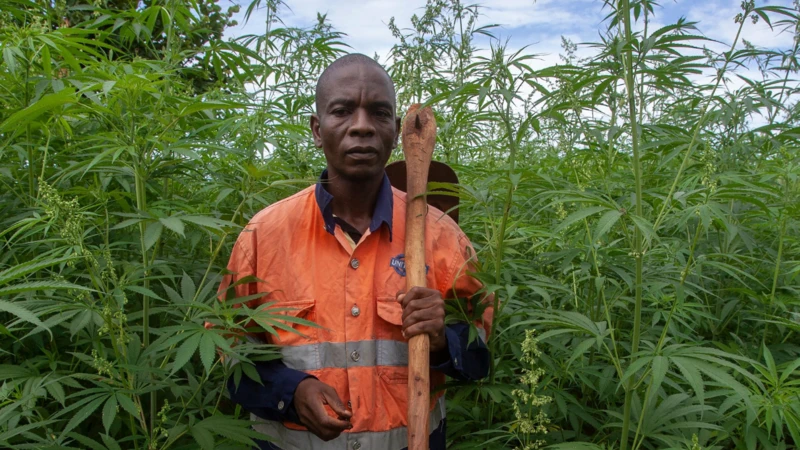
The government of Ghana has officially launched a regulated framework allowing the cultivation of cannabis for industrial and medicinal purposes, marking a major shift in the country’s drug policy and opening the door for investors and farmers to apply for licences.
Authorities say the initiative aims to create a tightly controlled cannabis industry focused on medical treatment, research and industrial applications, while maintaining a strict ban on recreational use of the plant.
The programme, announced in Accra during a government briefing, forms part of a broader effort by the Ghanaian government to diversify its agricultural sector, attract investment and unlock the economic potential of the global cannabis market.
Officials said the licensing regime will allow qualified applicants to cultivate, process and manage low-THC cannabis, commonly referred to as industrial hemp, under a strict regulatory framework.
The move follows the passage of the Narcotics Control Commission (Amendment) Act, 2023, which provides the legal foundation for regulated cannabis cultivation in the country.
Under the law, cannabis plants grown legally in Ghana must contain no more than 0.3 percent tetrahydrocannabinol (THC), the psychoactive compound responsible for the “high” associated with marijuana. This restriction ensures the crop is used primarily for medical products, pharmaceuticals, fibre production and other industrial uses rather than recreational consumption.
Government officials say the industry will operate under close supervision by the Narcotics Control Commission, which will oversee licensing, compliance and monitoring across the cannabis value chain.
According to the commission, only qualified applicants who meet strict requirements will be granted licences. These requirements include comprehensive security protocols, product traceability systems, quality assurance standards and full compliance with Ghanaian laws.
Prospective investors and companies have been advised to deal directly with the Cannabis Regulations Department of the commission and avoid middlemen or unauthorised agents claiming to facilitate licences.
Authorities say the goal is to ensure transparency and prevent the sector from being infiltrated by illegal operators.
Officials emphasised that while cannabis cultivation for industrial and medicinal purposes has now been legalised, recreational cannabis remains illegal in Ghana, and individuals caught producing or distributing it outside the regulated framework could still face severe penalties.
The legalisation marks the culmination of several years of legislative debate and regulatory reforms in the country.
Ghana’s parliament first passed the Narcotics Control Commission Act, 2020, which opened the door for the cultivation of cannabis for industrial and medical use under strict licensing conditions.
However, the rollout of the programme faced delays due to legal challenges and regulatory adjustments. In 2022, the country’s Supreme Court raised concerns about aspects of the legislation, forcing lawmakers to review and amend the law before full implementation could proceed.
Following these revisions, authorities finalized the regulatory framework and moved forward with the licensing regime.
Government officials believe the emerging cannabis industry could become a significant driver of economic growth in Ghana, creating jobs and attracting foreign investment.
Experts say cannabis is one of the most versatile agricultural plants in the world, with applications ranging from textiles, paper and fibre production to pharmaceuticals and cosmetics.
Industry analysts also note that the global cannabis market is expanding rapidly and could be worth billions of dollars in the coming years, presenting a major opportunity for countries with suitable climates for cultivation.
Ghana is widely considered to have favourable conditions for cannabis farming due to its tropical climate and fertile soil, which allow the plant to grow quickly and produce multiple harvests annually.
Supporters of the policy argue that a regulated cannabis industry could also help shift economic activity away from illegal cultivation and bring it under government oversight.
For decades, cannabis has been widely grown illegally in several parts of Ghana, particularly in the forest zones of the Ashanti, Brong Ahafo and Western regions, where farmers cultivated the crop covertly due to its profitability.
By introducing a legal framework, authorities hope to transform what was once an underground activity into a legitimate sector capable of generating tax revenue and boosting exports.
However, the new policy has already sparked debate within the country.
Some farmers and stakeholders have raised concerns about the high cost and strict requirements of obtaining licences, arguing that the rules may favour large corporations while excluding small-scale farmers.
Earlier in 2026, a farmer reportedly filed a case at the Supreme Court challenging the licensing framework, claiming the fees and conditions were too restrictive and could prevent ordinary citizens from participating in the emerging industry.
Despite the concerns, government officials maintain that strict regulation is necessary to prevent abuse and ensure the industry develops responsibly.
They say the licensing system will allow Ghana to benefit from the economic potential of cannabis while maintaining strong controls to protect public health and safety.
With the licensing process now open, industry observers believe Ghana could soon strengthen its position among a growing number of African countries developing regulated cannabis industries for medical and industrial purposes.