
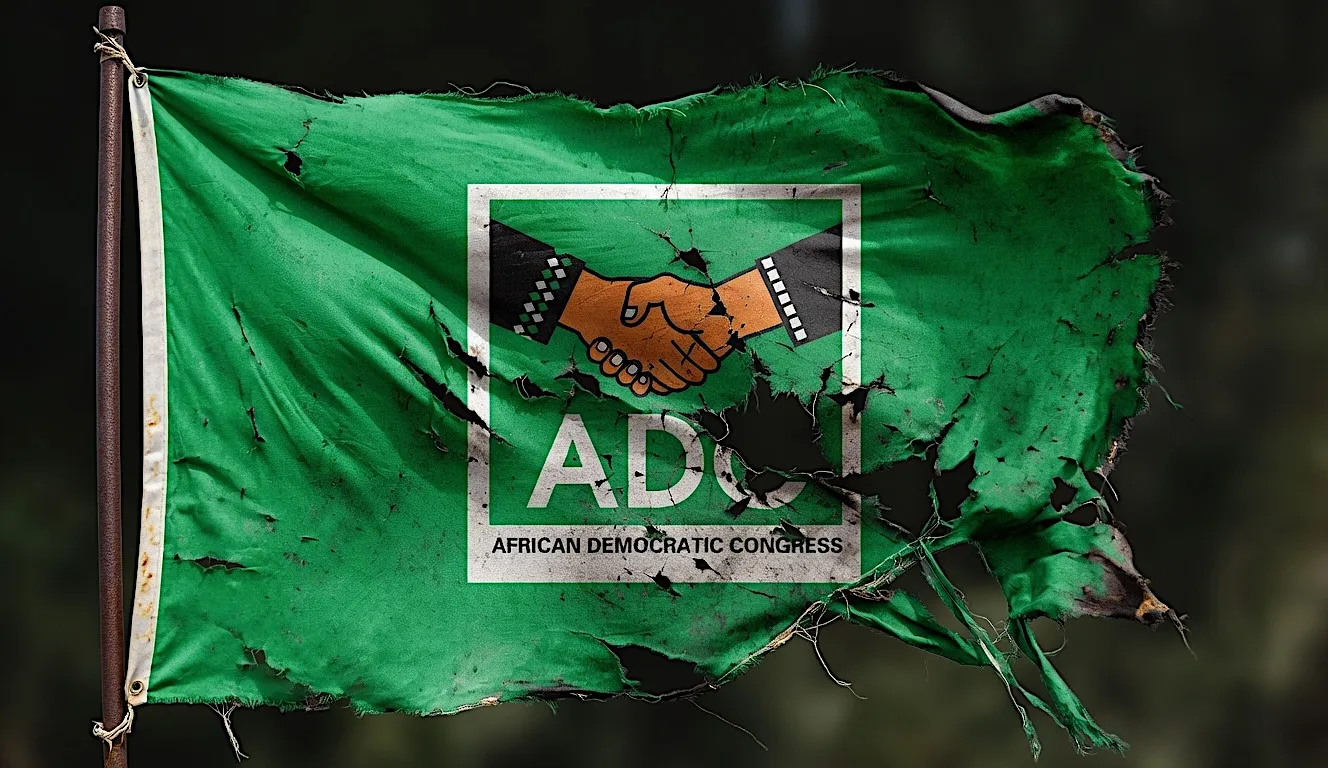
As the African Democratic Congress (ADC) barrels toward its 2026 nationwide ward, local government, state congresses, and the ultimate national convention, a storm is brewing in Delta State—a storm that threatens not only the credibility of the party but its very survival as a coalition force in Nigeria’s volatile political landscape.
The controversy centers on Engr. Austin Okolie, the Delta State Chairman of ADC, whose recent public notices and statements have exposed deep fissures within the party’s leadership and raised serious questions about internal governance.
On 25th March 2026, Okolie issued a public notice asserting that Professor Pat Utomi is the “duly recognized Leader of the Delta State Coalition.” According to the notice, Utomi, who ran as the ADC Presidential candidate in 2007, is entitled to lead the coalition in Delta State under the party’s National Working Committee (NWC) guidelines on coalition leadership.
Okolie emphasized Utomi’s political pedigree, including his tenure as Presidential Adviser to Shehu Shagari in 1983 and his numerous high-level appointments in the federal government. “Chief Great Ogboru remains a respected and prominent leader in Delta State politics; however, he is not the Delta State Coalition Leader,” Okolie stated, in what he described as an effort to bring clarity. Instead, the notice has ignited a raging internal firestorm.
Within days, the ADC Transitional Leadership Team in Delta State fired back, accusing Okolie of sowing discord and deliberately undermining the national party’s unification efforts.
Elder Fred Akpewe, a senior member of the state leadership team, described Okolie’s actions as “divisive and provocative,” portraying a chairman acting independently, flouting directives from the national leadership, and jeopardizing the coalition structure painstakingly established under Senator David Mark.
The leadership team outlined several troubling developments. Despite being a member of the Delta State MRMR (Membership Revalidation, Mobilization, and Registration) Committee, Okolie reportedly bypassed committee procedures and ignored repeated invitations to official meetings.
He allegedly instructed party members to collect expression-of-interest forms for congresses exclusively from the Midwifery Road secretariat in Asaba, threatening to invalidate forms obtained elsewhere. The Transitional Leadership Team insists this directive is misleading, as forms are also officially available at a separate leadership secretariat along DLA Road, a standard arrangement in coalition politics.
Okolie has also reportedly refused to attend a unification meeting organized by other state leaders in compliance with Senator Mark’s directive to consolidate all party tendencies ahead of the congresses.
The leadership team likened Okolie’s conduct to that of an agent provocateur, warning that his unilateral moves risk misleading well-meaning but uninformed party supporters. “Some ill-informed but innocent supporters of Austin Okolie are still in an ill-fated ship heading to hit the rocks. The ship is rudderless, has no sails, and no compass,” the statement read.
At first glance, this may appear as a dispute over titles, but sources within ADC insist the stakes are far higher. Delta State is politically strategic, and the party’s success there could determine its relevance on the national stage.
Analysts stress that the ADC’s coalition model relies on the seamless integration of multiple smaller parties—including the PDC, APC, and Labour Party factions—under a unified leadership umbrella. Any perception of disunity could weaken the coalition’s bargaining power and provide opponents with a narrative of dysfunction.
Dr. Leo Ebinim, chairman of the state MRMR committee, warned that Okolie’s unilateral actions could undo months of meticulous preparation. “The work of the MRMR committee has been extremely successful, supervised by our national representative, Professor Festus Arunaye. Yet, actions like those of Okolie threaten to undo progress and misrepresent the party’s internal cohesion to the public,” Ebinim said.
The Transitional Leadership Team emphasized that Senator Mark has repeatedly directed all factions to cooperate and operate under a single strategic vision. Okolie’s refusal to follow these directives is widely viewed as a personal power play rather than an effort to strengthen the party.
The controversy is further complicated by the existence of parallel ADC secretariats in Delta State and at the national level in Abuja. The national ADC secretariat operates at 121 Adetokunbo Ademola Crescent, Wuse 2, while a secondary office at Oyo Street, Garki, remains functional. Similarly, Delta State hosts both the Midwifery Road office, used by Okolie, and the DLA Road office, operated by the state leadership team.
The Transitional Leadership Team argues that Okolie’s insistence on centralizing operations at Midwifery Road, while ignoring DLA Road, is inconsistent with coalition practice and a deliberate attempt to monopolize control over congress procedures. “It is a well-known fact that in coalitions, multiple secretariats exist side by side. Even at the national level, there is no friction between offices. It is only Okolie who refuses to comply with the pre-established structure of the Delta State leadership team,” Akpewe stated.
This leadership feud comes at a critical time, as the ADC gears up for a tight schedule of activities for 2026. Membership mobilization, revalidation, and registration runs from 12th February to 16th April. Notice of congresses was issued to states on 13th March, with forms for wards, LGAs, and state congresses to be purchased and submitted between 14th and 20th March.
Polling unit and ward congresses are scheduled for 7th April, local government area congresses for 9th April, state congresses on 11th April, and the national convention on 14th April. Sources indicate that any disruption in Delta State could cascade into delays nationwide, undermining the party’s credibility ahead of general elections.
Prince Chinedu Idigo, the National Organizing Secretary, confirmed that expression-of-interest forms for congressional aspirants are to be collected from the officially sanctioned leadership secretariat free of charge, with conditions for eligibility clearly stipulated. Okolie’s instructions, however, have reportedly created confusion, contradicting national party procedures and threatening the integrity of the electoral process within the party.
While Okolie’s supporters maintain he is asserting the rights of a state chairman to manage internal affairs, the Transitional Leadership Team frames his actions as a transparent attempt to undermine coalition leadership, potentially for personal gain. Akpewe and colleagues allege that Okolie seeks to position himself as the Delta State ADC Coalition Chairman, a role currently held by Pat Utomi under NWC guidelines.
In their view, his maneuvers are less about procedural clarity and more about consolidating power, even at the risk of factionalism. Political analysts argue this episode exemplifies a recurring tension in Nigerian party politics: the clash between established hierarchies, which seek orderly governance, and ambitious local actors willing to flout rules to gain influence.
Dr. Funke Adebanjo, a political commentator, observed, “What we are seeing is a classic example of the friction between institutional authority and individual ambition. If left unchecked, it could not only destabilize the ADC in Delta State but also provide a cautionary tale for coalition politics nationwide.”
Despite the escalating tension, ADC leadership insists there is still time to avert a full-blown crisis. The Transitional Leadership Team has called on party members to “stay united in one ship” and follow directives from the National Working Committee. “The assessment of a leader cannot be done by the profundity of his words or actions but by the strength of his character. The State ADC Leadership team has exercised extreme restraint in the face of so many provocations coming from Austin Okolie,” the statement reads.
Observers stress that the coming weeks are critical. With polling unit and ward congresses scheduled for 7th April and state congresses on 11th April, any failure to resolve leadership disputes could create confusion over who legitimately controls party machinery at local and state levels. The looming national convention on 14th April further heightens the stakes, as internal fractures could translate into weakened bargaining power for Delta State delegates.
The implications of this feud go beyond Delta State. On one hand, the ADC has a rare opportunity to solidify its coalition model and present itself as a credible alternative to dominant parties. On the other hand, the ambitions and unilateral actions of a single state chairman threaten to unravel months of strategic planning and coalition building. The drama unfolding in Delta State serves as a microcosm of a broader struggle within Nigerian politics: the tension between personal ambition and collective responsibility, the challenge of coalition governance, and the fragility of party unity in a high-stakes electoral environment.
For now, the ADC leadership in Delta State and at the national level faces a pivotal choice: rein in a disruptive actor and safeguard the party’s cohesion or allow factionalism to fracture a coalition that has taken years to construct.
The coming weeks will reveal whether the ADC can navigate these turbulent waters or whether the ambitions of Engr. Austin Okolie will push the party toward an avoidable crisis—one that could have profound implications not only for Delta State but for the future of coalition politics in Nigeria.